Category: Beyond Work

Beyond Work is our line of resources for people and community leaders looking for something new and innovative outside, be it a new job, career change, or personal development outside of work.

  • Start the New Year Right with Simplicity

    Start the New Year Right with Simplicity

    At the beginning of a new year, there is a natural pull toward momentum. Fresh calendars, renewed energy, and the promise of progress invite us to jump straight into action. But at Horizon Point Consulting, we believe sustainable success starts with intention—not urgency. Starting the year right means slowing down just enough to be thoughtful, focused, and aligned.

    Here is a simple, disciplined approach we often recommend to individuals and organizations alike.  And you need to write this all down! Don’t just do it in your head. Reflection becomes far more powerful when it moves from your head to paper.

    1. Reflect 

    Before you plan what’s next, take time to reflect on what has been. Two ways to do this are through documenting: 

    Highs and Lows

    Begin by capturing the highs from the past year. What worked? Where did you feel proud, energized, or successful? These moments often reveal strengths and strategies worth repeating.

    Then, honestly document the lows. What felt heavy, frustrating, or misaligned? Where did you lose energy or momentum? Naming these experiences helps you learn from them rather than carry them forward unconsciously.

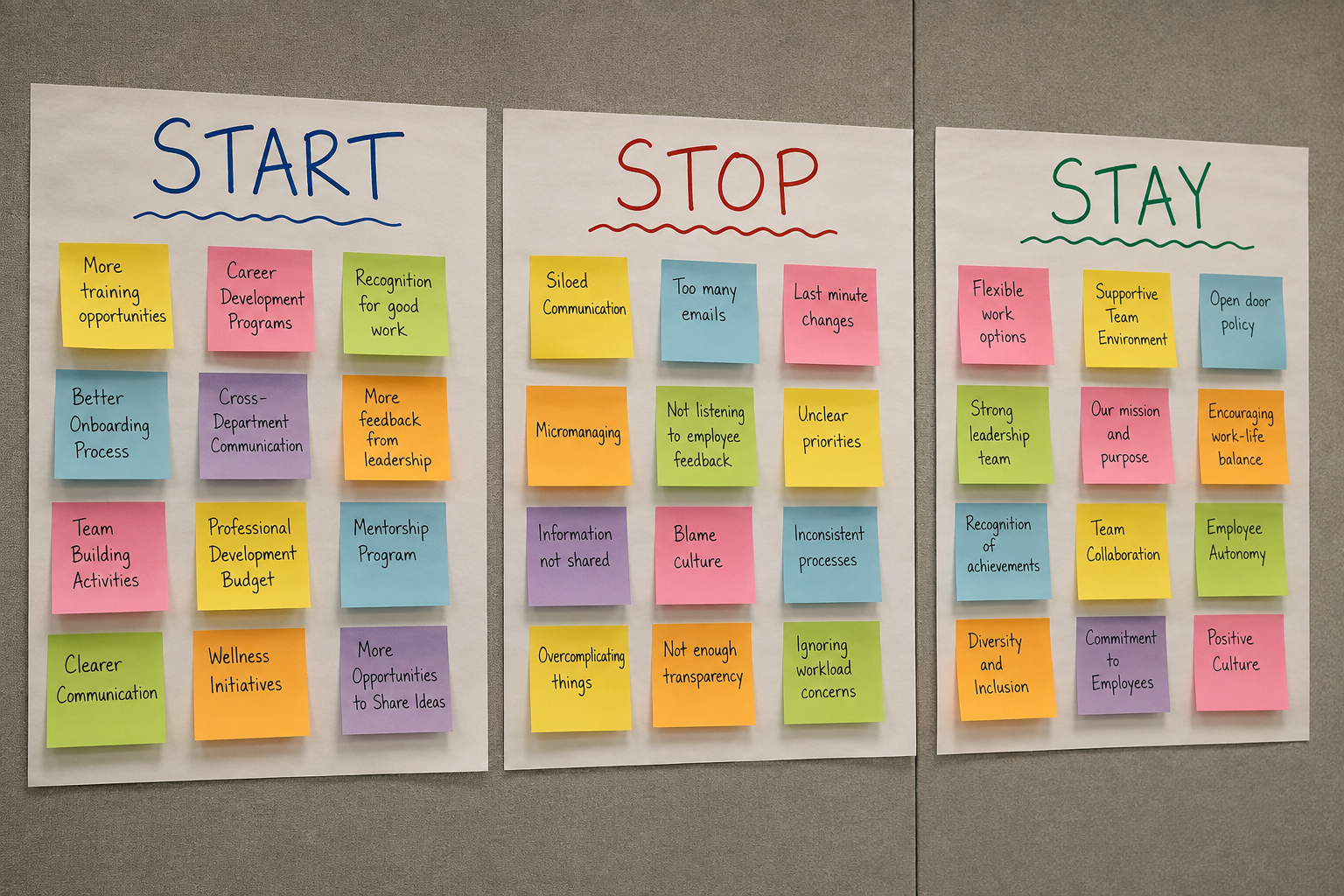
    Start, Stop, Stay

    Next, organize your reflection into three simple categories:

    • Start: What new habits, behaviors, or practices would serve you better this year?
    • Stop: What is no longer working and needs to be released?
    • Stay: What is already working well and should be protected or reinforced?

    This exercise brings clarity and creates a strong foundation for meaningful change.

    Mel Robbin’s Best Year Workbook highlights a reflection on both of these things and may help you get these reflections down on paper. 

    We also like Emily Freeman’s 10 Questions for Reflection and Discernment


    2. Plan — Then Put It on the Calendar

    Reflection without planning rarely leads to results. Once you’ve identified what matters most, it’s time to plan.

    The key here is specificity. Good intentions become real commitments when they are scheduled. Block time for priorities, not just tasks. And understand your natural rhythms to know when the best time is to do what type of activities.  We outline how to do a time audit and other important “when” topics here. Whether it’s strategic thinking, personal development, health, or connection, if it matters—it deserves space on your calendar.

    You also may want to check out Cal Newport’s planner and podcast for more insights on purposeful planning for “deep work” and “slow productivity.” 

    And then, the harder part: stick to it. Treat these commitments with the same respect you give meetings and deadlines. Consistency is where progress compounds.

    3. Simplify

    Starting the year right doesn’t mean doing more. In fact, it often means doing less—on purpose.

    We simplify at HPC by selecting a theme for the year.  Here are some of our previous themes: 

    Ironically enough, our theme for 2026 HPC is “Simplicity.” 

    Look at your commitments, goals, and routines and ask: What can be simplified? Where can you reduce complexity, eliminate distractions, or streamline processes?  We will be working through all of these things this year at HPC. 

    We are starting off this year simplifying our blog and newsletters.  Blogs will be released once a month, not once a week, along with a newsletter.  Often, less is more. 

    Simplicity creates focus and it takes intention.  We are focusing on this in 2026. 

    4. Share

    Goals grow stronger when they are shared. Whether it’s with a colleague, a team, a coach, or a trusted friend, articulating your intentions out loud builds accountability and clarity.

    Sharing also invites support. You don’t have to carry the year alone—and you shouldn’t.

    In fact, with our Doer2Leader (D2L) leadership training, everyone picks an accountability partner so they are sharing their goals and sharing their progress throughout the six month program. 

    We have three groups starting this month and have a spot or two left for more- email us to set up a call to talk about your need!

    5. Calibrate Regularly

    Finally, remember that the year is not a straight line. Starting strong matters, but recalibrating regularly matters more.  Every year will no doubt require pivots. 

    Build in moments—monthly or quarterly (we like to do it quarterly)—to revisit your reflections, plans, and priorities. Ask what’s working, what’s shifting, and what needs adjustment. Calibration keeps you aligned as conditions change.

    Starting the new year right isn’t about perfection or pressure. It’s about clarity, intention, and disciplined follow-through. When you reflect honestly, plan deliberately, simplify courageously, share openly, and calibrate regularly, you create a year that is not just busy—but meaningful.

  • What Cultivates Gratitude? Or Better Yet, What Does Gratitude Cultivate?

    What Cultivates Gratitude? Or Better Yet, What Does Gratitude Cultivate?

    This week we are featuring a reblog from Mary Ila, originally published November 23, 2021.

    I was tasked with writing a blog post on gratitude for this week- Thanksgiving week. I love it when my team gets together without me while I’m on sabbatical and sends me an email telling me what to write 🙂  It’s a given- a post with a theme of thankfulness- even though as a culture we’ve seemed to skip right to Christmas once Halloween ends. 

    I’ve written about counting your blessings and even counting your first-world problems and being thankful when tasked with the same thing before. 

    But what keeps jumping back into my mind this year as I think about how to articulate some inspiration for gratitude is to cite Bryan Stephenson. I had the opportunity to hear Stephenson at a conference I attended this fall.  Bryan Stephenson is the author of Just Mercy and founder of the Equal Justice Initiative.  

    He is obviously an in-demand speaker.  He apparently charged the group nothing for an almost hour-long talk.  He started the session by thanking the people in the audience for the work they do.  Mostly public servants in the audience who spend their days helping people on the margins, he made reference to how some of the services the group was involved in impacted him as a child. 

    He thanked and he thanked and he thanked before he moved into any form of argument or points. 

    But his points were powerful, and also speak to a heart of gratitude I believe that then leads to a heart of grace and mercy, and then one of action. 

    In speaking about the marginalized, or “least of these” Stephenson made four points: 

    1. Commit to getting proximate.  We can’t help if we aren’t close because then we don’t know what we don’t know.  We need to affirm people’s humanity to help them get to higher ground and realize that all our journeys are tied to one another.  
    2. We have to change our narratives.  This means we have to talk about things we haven’t talked about before.  He says we have to, “acknowledge, confess, and repent.”  My favorite quote of the night was, “Beautiful things happen when we tell the truth.  We close ourselves off to beauty when we don’t tell the truth.” 
    3. We have to believe in hope.  This means believing in things we haven’t yet seen and being confident that in getting proximate and changing narratives, they will become seen. 
    4. We have to do things that are uncomfortable and inconvenient.  Really, the first three things echo this point.  Getting proximate is uncomfortable and inconvenient.  Changing our narratives and telling the truth is uncomfortable. Staying hopeful is not only uncomfortable, it is also inconvenient to train our brains to be so.  But in the end, and in the journey itself, that is where the beauty lies. 

    I hope you’ll take this week to be thankful and it will lead you to grace and mercy, which will then inspire you to action.  

    During this holiday season, where do you need to get proximate, change a narrative, have hope, and/or be uncomfortable or inconvenienced? 

  • Nourishing Growth Through Gratitude, Common Ground, and Kindness

    Nourishing Growth Through Gratitude, Common Ground, and Kindness

    A Note from HPC: We’ve had the privilege of working with Cummings Research Park to provide leadership training for high-potential professionals who are shaping innovation in Huntsville, Alabama. The class sessions were hosted at HudsonAlpha, where Dr. Neil Lamb serves as president. During one session, Dr. Lamb joined us as a “leadership in action” guest speaker, sharing his story and insights on purpose-driven leadership. When Mary Ila began planning this special feature for our Nourish theme, she immediately thought of Dr. Lamb as the perfect guest contributor. He agreed that his recent commencement speech at Auburn University captured the message beautifully. And as a two-time Auburn graduate myself, I couldn’t agree more. You can watch the full speech at the end of this blog post. 

    When Dr. Neil Lamb stood before Auburn University’s Class of 2025, he began with honesty and humor. He admitted he could not remember a single word from his own graduation speaker 33 years ago. What he did remember was sitting a few rows away from the woman who would become his wife, a love story that began at Auburn and continues today.

    That story set the tone for a message about what truly sustains us. Dr. Lamb, now president of the HudsonAlpha Institute for Biotechnology, has built a career on advancing science and education. Yet his advice to graduates was not about innovation or research. It was about how to live and lead in a way that nourishes ourselves and others.

    He called on the audience to practice three habits that have the power to shape lives, teams, and communities: gratitude, common ground, and kindness.

    Gratitude: Nourishing Connection

    “Take a moment,” Dr. Lamb urged, “and think of three people who have supported you, believed in you, or pushed you to get to where you are today.”

    Gratitude, he said, is not just for special occasions. It is a daily practice that keeps us connected to what matters most. At Horizon Point, we often talk about nourishing relationships. Gratitude is how that nourishment begins. It reminds us that none of us reach success alone.

    Expressing appreciation builds stronger teams and healthier workplaces. It creates space for joy and perspective, even in times of challenge. When we take the time to say “thank you,” we invest in the human side of work.

    Common Ground: Nourishing Understanding

    In a world filled with division, Dr. Lamb encouraged graduates to seek common ground.

    “You can hold deep convictions while still recognizing the dignity of others,” he said. “Finding common ground isn’t compromising your values. It’s choosing connection over contempt.”

    That kind of leadership starts with curiosity. It is the willingness to listen longer, to stay in the conversation when it gets uncomfortable, and to look for shared purpose instead of differences.

    When we nourish understanding within teams and organizations, collaboration thrives. Trust grows. Solutions emerge. As Dr. Lamb reminded the audience, finding common ground does not mean giving something up. It means building something stronger.

    Kindness: Nourishing Culture

    Dr. Lamb called kindness a “stealth superpower.” It diffuses tension, invites generosity, and changes lives in small and large ways.

    Kindness does not mean ignoring conflict or injustice. It means seeing the humanity in others, especially those who challenge us. It means offering grace when judgment would be easier and patience when frustration feels justified.

    In the workplace, kindness nourishes culture. It sets the tone for how people feel, how they show up, and how they grow. When kindness leads, people are more open, resilient, and ready to contribute their best.

    Belonging and Self-Doubt

    Dr. Lamb also spoke candidly about his own struggle with impostor syndrome. As a student, he felt like he had “slipped through the cracks” and did not truly belong at Auburn. It took years, mentors, and self-reflection to realize that he was right where he needed to be.

    To anyone carrying similar doubts, his message was powerful:

    “You are not here by luck or by mistake. You are here because you deserve to be.
    You will belong in the rooms where ideas get born, where decisions get made, and where the future takes shape.”

    At Horizon Point, we believe belonging is part of being nourished. When people feel seen, valued, and included, they can bring their full selves to their work and their communities.

    A Nourishing Way Forward

    Dr. Lamb closed with a challenge that aligns beautifully with our theme this year:

    Carry gratitude.
    Seek common ground.
    Be kind.

    These are not “soft” skills. They are essential skills that sustain leadership and nourish the people around us.

    Whether you are crossing a stage, leading a team, or facing a personal transition, these three habits can ground and guide you. Gratitude connects. Common ground unites. Kindness uplifts. Together, they nourish growth that lasts.

    “Auburn has prepared you well,” Dr. Lamb said. “You are more than ready. And we can’t wait to see what you do next.”

    War Eagle to that.

  • Driving Workforce Excellence in a Changing World

    Driving Workforce Excellence in a Changing World

    Highlights from Mary Ila Ward’s keynote at the 2025 Southern Automotive Conference

    At the 2025 Southern Automotive Conference, our very own Mary Ila Ward took the stage to explore a question that’s top of mind for every business leader today: How do we drive workforce excellence in a world that’s changing faster than ever?

    Drawing from more than 20 years of experience in workforce strategy, Mary Ila shared an engaging, thought-provoking keynote that connected history, data, and humanity to the future of work, especially in the automotive and manufacturing sectors that keep the South moving.

    Where We’ve Been

    Mary Ila began by taking the audience back to 1926, when Henry Ford introduced the 40-hour, five-day workweek—a radical change that reshaped the modern workplace. Nearly a century later, she challenged the crowd to consider whether that model still works in today’s “always-on” digital world.

    “We’re living with a 24/7/365 mindset,” she noted, “and it’s taking a toll on our health, relationships, and overall performance.”

    From there, she painted a picture of the societal shifts shaping our current reality (all of which she’s talked about before on The Point Blog): the decline of play-based childhood and the rise of phone-based childhood, falling birth rates, fewer working-age males, and shifting immigration patterns. “We simply aren’t replacing ourselves,” she said, in a wake-up call for industries already struggling to find and keep skilled workers.

    Where We Are

    The current landscape, as Mary Ila described it, demands both individual and organizational adaptability. Excellence starts with small, intentional habits, like these “three small habits” for personal excellence as described on The Mel Robbins Podcast:

    1. Move. Physical activity boosts focus, health, and resilience.

    2. Put the phone down. Disconnection fosters creativity, presence, and balance.

    3. Build relationships. Genuine human connection drives collaboration and engagement.

    Each of these habits was paired with a simple challenge, like doing daily push-ups, spending a set time “phoneless,” or writing gratitude notes, to illustrate how small shifts create lasting change.

    Modeling Excellence for Others

    Beyond personal habits, Mary Ila emphasized the responsibility leaders have to model excellence for their teams. That starts with living in alignment with one’s values and setting clear boundaries between work and personal life.

    “Don’t make people work outside of work hours, and don’t do it yourself,” she urged.

    She also encouraged leaders to have regular one-on-one meetings with their direct reports and to focus less on solving problems and more on developing people. Recommending our friends at Mind Your Culture and the Integrity Coaching® framework, she outlined a leadership approach built on recognition, trust, and accountability. “We develop excellence by helping others find their own,” she said.

    Where We’re Going

    Looking ahead, Mary Ila challenged organizations to expand the labor pool and rethink traditional work models. Solutions she highlighted included:

    • Considering the “Success Sequence” as one path to help more men enter and stay in the workforce.

    • Improving childcare availability, affordability, and access.

    • Supporting immigration reform that bolsters the labor force.

    • Investing in second chance programs (like Onin Flex) to reengage people returning to work.

    • Rethinking shift structures and flexible work arrangements to meet modern expectations.

    “Our workplaces need a paradigm shift,” she said. “Just like Henry Ford changed the model 100 years ago, it’s time for us to do the same.”

    Moving Forward

    Mary Ila closed her keynote with an invitation to lead differently, by starting small, focusing on people, and building communities of excellence across departments, organizations, and industries.

    The message resonated with attendees who left inspired to take practical steps toward stronger, healthier, more human-centered workplaces.

    Because as Mary Ila reminded the audience, “Driving workforce excellence starts with driving personal excellence—together.”

  • When Your Side Gig Deserves Center Stage

    When Your Side Gig Deserves Center Stage

    We’ve been talking about side gigs lately. One of the toughest parts is deciding if or when to make the side gig the main gig. It’s often not as simple as we’d like it to be.

    A few weeks ago, I spent some time in Virginia with my parents and brought along a small project, an old desk I’d found at a thrift store for $20. It had good bones but had definitely seen better days.

    My dad and I spent the week together in his woodworking shop, sanding, repairing, and refinishing it until it was restored to its former glory. Somewhere between the smell of sawdust and the hum of the sander, I learned that the desk was more than a hundred years old and made of solid walnut, a piece that had clearly stood the test of time.

    Watching my dad work reminded me how he’s done the same thing with his own career. What started years ago as a hobby, tinkering in his workshop on weekends, has now become part of his full-time work. After decades in construction, he’s blended his craftsmanship with his trade, flipping houses that feature his custom woodworking, accent walls, built-in bookcases, and hand-crafted cabinets that give each home its own story.

    That desk became more than a project. It was a reminder that sometimes what we start on the side, simply because we love it, can evolve into something much bigger. According to a recent study by Side Hustle Nation, 39% of working Americans have a side hustle, and about one in five hope to eventually turn it into a full-time job. It’s not always easy to know when it’s time to take that leap, but there are signs it might be time to let your side gig take center stage.

    Just like restoring that old desk revealed the strength of the wood beneath the surface, your side gig can show signs of its own potential if you take the time to notice them.

    When…your side gig is financially sustainable.

    Your side gig is showing steady, reliable growth. You have repeat customers, new ones finding you regularly, and your income has moved from covering basic costs to turning a profit. You’re not just staying afloat, you’re seeing enough green to pay essential expenses and keep the business running. Better yet, it’s bringing in enough money to replace or nearly replace your current salary.

    When…you’re running out of time and energy.

    With steady growth comes the need for more time, and there are only so many hours in the day. You find yourself waking up early or staying up late to keep up with demand, juggling both your full-time job and your side gig. Eventually, something has to give. When you can’t devote the time your side gig needs, growth stalls and sales may even start to dip. That’s often a sign your business has outgrown the “part-time” label.

    When…your passion has shifted.

    What started as a creative outlet or a way to earn a little extra each month has become the work that brings you the most joy. You find yourself energized by your side gig and counting down the hours until you can get back to it. Meanwhile, your full-time job starts to feel more like an obligation than an opportunity. When your passion shifts that strongly, it’s worth paying attention. It may be pointing you toward what you’re truly meant to do.

    Like that old walnut desk, sometimes the things we start just for the love of it reveal a strength and potential we didn’t see at first. When your side gig shows financial promise, demands more of your time and energy, and becomes the work that truly lights you up, it might be more than just a hobby. It might be your next chapter waiting to unfold.

    Taking the leap isn’t about abandoning stability. It’s about building on something that’s already proven its worth. As you consider what you need to start, stop, and stay, both personally and professionally, ask yourself what your side gig could become if you gave it your full attention.

Subscribe to The Point Blog!

Our consultants write about new research, our work, our lives, and everything in between. Subscribe to The Point Blog for our weekly stories.