
Category: Beyond Talent

Beyond Talent is our line of resources for professionals in the workplace who are individual contributors without people supervision responsibilities. Read this category for blogs on professional and career development to excel in your current role or help you prepare for your next level career.

  • 15 Years of Workplace Innovation. What Will the Next 15 Bring?

    15 Years of Workplace Innovation. What Will the Next 15 Bring?

    It’s the summer of anniversaries. On July 4th our country will celebrate its 250th anniversary.  Relatively young for a country, but a milestone nonetheless.

    In August, my husband and I will celebrate 20 years of marriage. Still possibly a young marriage, but a milestone anniversary as we enter our midlife years.

    And this summer, Horizon Point celebrates our 15th anniversary. Established as a business- but still an adolescent- we’ve always been predicting and navigating what will happen next when it comes to the workplace.

    Fifteen years ago, writing my first blog post seemed to be the official way to announce the business. I looked for the post and that first platform of those infant writings, but couldn’t find it.  It was written on a platform that is long forgotten and no longer in existence.

    The post played off the theme of Sarah Bareille’s song “Uncharted”. And boy, we’ve navigated some uncharted territory-some anticipated and some totally unexpected- shaping the workplace.

    How the Workplace Changed Over the Past 15 Years

    In 2011, smartphones were taking over, millennials were taking over, and cloud computing was changing how we worked and collaborated.  We were coming out of the “Great Recession” yet many employers were still complaining about the quality and quantity of labor.

    Throughout the first several years of business, “employee experience” became a buzz phrase, people wanted to constantly talk about the five generations in the workplace and what it meant and DEI initiatives began to take off.  “Wellness” became a workplace strategy.

    As we approached 2020, remote and hybrid work largely driven by technology and the desire to retain and expand talent pools began to creep up on all of us.  Around 2018 we began to get an explosion of calls about help with compensation. We were still largely operating at recession wages ten years after the recession. Then the pandemic hit and accelerated these paths exponentially.

    The Great Resignation hit and we were up to our eyeballs at work helping a diverse set of employers recruit and retain talent in this new paradigm.

    And although I wouldn’t have dreamed of all that AI can do and how it could help me write a blog post fifteen years ago- yes, I did dump the topic for this blog post in ChatGPT to help me begin- there are some things that still remain the same and will continue to shape the workplace for the next 15 years.

    Looking Ahead: What the Next 15 Years May Bring

    Here are my predictions:

    How and Where Work Gets Done:  We will still be “arguing” over the mix of work- remote, hybrid, in office, etc. etc.- and what is best universally and by company and industry. We will still be arguing what makes people most “productive”.

    I found Adam Grant’s most recent research interesting around why and what type of boss wants people to return to the office full-time.  Spoiler alert: it isn’t really about productivity.

    I myself have re-examined this in the last year or so, to a varying degree of extreme.  We’ve always had the core values of people first coupled with productivity driving us to not care “when and where work gets done as long as it meets the client’s needs.”  We all work from home and work based on client demand and our own personal time clocks and rhythms to maximize our motivation, productivity, and outcomes. This looks different for each of us.

    But as we transition into year sixteen of the business, I will be relocating with my family six hours away from where I’ve done life and business for the last fifteen years. I still have total confidence work will get done to meet client needs. Will it look different, yes, but it will still be work getting done. If you want to read more about our decision to move, you can find it here. Home and work, at least in my industry, can be almost anywhere in 2026 and beyond.

    As technology continues to advance, even 24/7 industries like healthcare, public service/safety, and manufacturing will have to examine if it will be realistic to operate 24/7/365 without some drastic changes.  Because what will drive all this is the next one…

    Our quality and quantity labor crisis will only grow:  We aren’t making enough babies in the United States or across the world.  Immigration policy is a hot button and I believe will remain so for the near future.  People are exiting the workplace left and right, some for valid reasons, like a much deserved retirement, and for some not so good, for example, the decline of working-age men in the workplace and what this idleness is causing.

    We’ve written about all of this extensively.  You can find more about this labor crisis that will only grow here:

    The Evaporation of Male Labor Force Participation

    What’s Affecting the Labor Force Participation Rate?

    We will still need (and there will still be a gap in) good leadership:  If you asked me at the beginning of 2026 what we would receive the most requests for this year, I honestly would not have said leadership training. Boy was I wrong.  We are getting a minimum of 1-2 requests a week for leadership training proposals, and I’m not talking about a one-and-done stab at leadership development.  I’m talking months and months of a willingness to invest in identifying and growing leaders.

    Driven by the first two above, the quality (and quantity) of good leaders will be needed.  And it will be about embracing authenticity, vulnerability, bravery, and courage. It will demand self-differentiated leaders. For more on this visit work done by Brene Brown and the late Edwin Friedman.

    And like we’ve often said, what got you here won’t get you there. Good leaders can be grown, but it takes training in a different type of skillset than being a good doer.

    With this in mind, we have launched the Doer2Leader Program to meet this demand that isn’t going anywhere.

    AI will continue to shape the workplace and the classroom: I used AI sparingly just a year ago. I use it pretty much every day now. My kids use it on the regular for school and non-school related things. How will it look in 15 years? I’ll leave that to the experts in the field to discern, but I know it will make an impact.  We will need people who know how to leverage constantly evolving technology wisely. I don’t think it is going to largely replace humans at work, or at least not to the extent that number two above won’t continue to be a problem.

    Education will continue to need to focus on in-demand skills, not degrees, but it will continue to need to help students know how to think, not just do:  It’s hard for me not to look at this from the lens of a mother instead of someone trained in organizational psychology.  Although I’m not sure of the means to get to it (and how the trends in school choice do or don’t impact it), I do know we’ve got to do education better.  We’ve made strides in the last fifteen years in resurrecting the focus on career and technical education. But, in my opinion, we still aren’t doing enough to integrate cross disciplinary instruction and thinking as well as character development into our educational pedagogy across the country.

    We are largely still asking kids to memorize things they can look up online, structuring classrooms like we did during the industrial revolution and failing to show students how to connect the dots across multiple disciplines, ideas, and basic life skills. Haves and have nots continue to be further divided based on who gets this type of learning in the home and who doesn’t.

    The “traditional” worker will shrink: Those who think and not just do will not stay in the “traditional” workplace. They will go out on their own and do their own thing or work for someone who will let them do so. They won’t be governed by corporate policy or the corporate grind and by work hours and mindsets that aren’t conducive to their lifestyle desires or pay systems that don’t reward them for their value and performance. Some will couch this along the lines of generational issues, but I think there is more to it than that.

    The best and brightest will leverage technology, interpersonal skills, and vision, and tell the workplace to peace out if it doesn’t get a grip with things mentioned above and the value they create. I am seeing this in droves now and it will continue.

    This will continue to separate the haves from the have nots (for which I am concerned) and place more of a demand on traditional employers and educators to figure out how to train and lead marginalized groups. This drives a set of challenges we’ve got to figure out as a collective how to address.

    The One Prediction I’m Confident Making

    I’ll be wrong and I’ll be right about some of these things.  But what I know for sure is we will have to keep innovating the workplace if we will continue to be relevant as a business and if any other organization will be for that matter.

    What are you expecting the future of work and the workplace to look like and how do you stay on top of the constant evolution?

  • Driving Workforce Excellence in a Changing World

    Driving Workforce Excellence in a Changing World

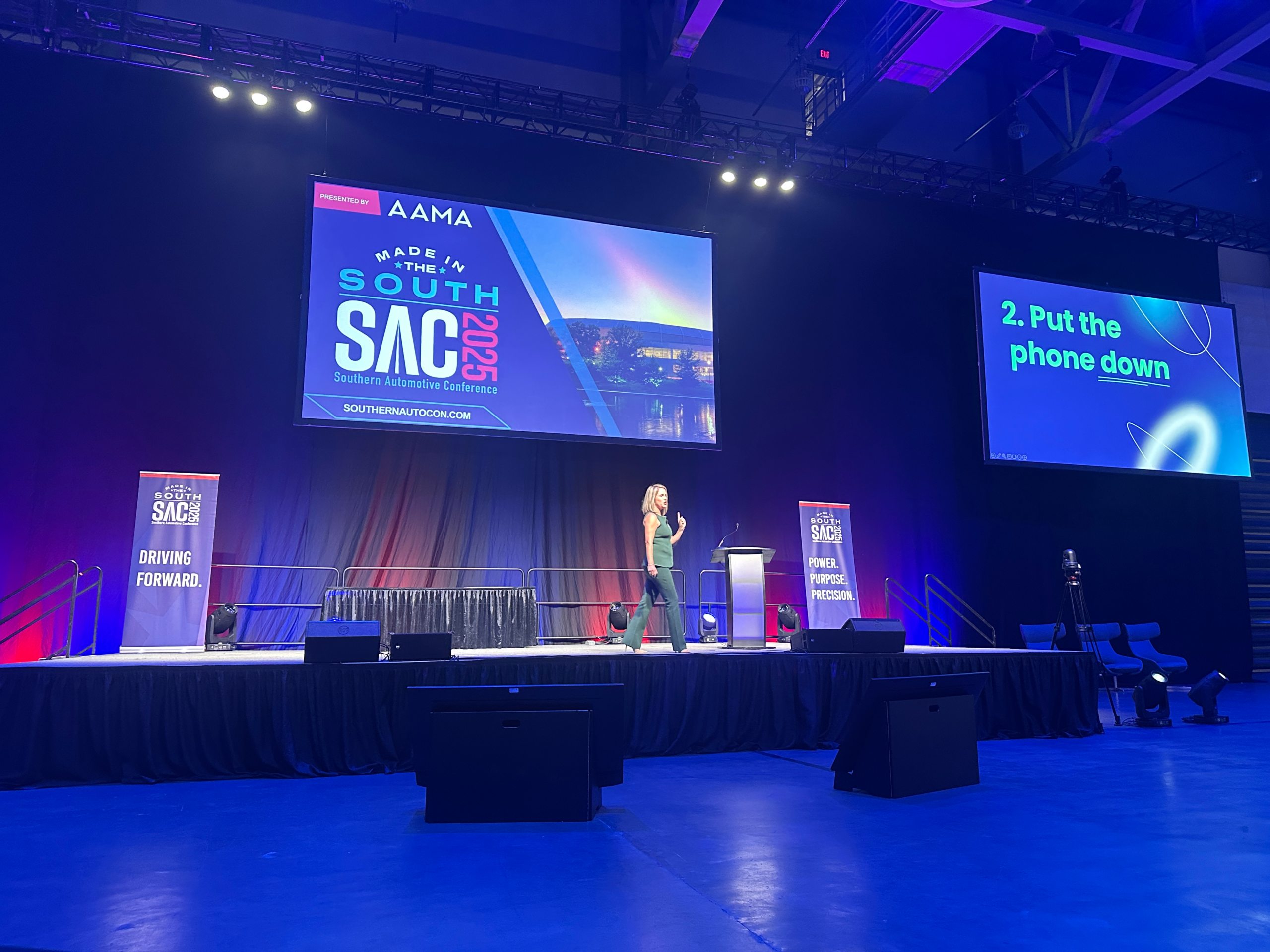
    Highlights from Mary Ila Ward’s keynote at the 2025 Southern Automotive Conference

    At the 2025 Southern Automotive Conference, our very own Mary Ila Ward took the stage to explore a question that’s top of mind for every business leader today: How do we drive workforce excellence in a world that’s changing faster than ever?

    Drawing from more than 20 years of experience in workforce strategy, Mary Ila shared an engaging, thought-provoking keynote that connected history, data, and humanity to the future of work, especially in the automotive and manufacturing sectors that keep the South moving.

    Where We’ve Been

    Mary Ila began by taking the audience back to 1926, when Henry Ford introduced the 40-hour, five-day workweek—a radical change that reshaped the modern workplace. Nearly a century later, she challenged the crowd to consider whether that model still works in today’s “always-on” digital world.

    “We’re living with a 24/7/365 mindset,” she noted, “and it’s taking a toll on our health, relationships, and overall performance.”

    From there, she painted a picture of the societal shifts shaping our current reality (all of which she’s talked about before on The Point Blog): the decline of play-based childhood and the rise of phone-based childhood, falling birth rates, fewer working-age males, and shifting immigration patterns. “We simply aren’t replacing ourselves,” she said, in a wake-up call for industries already struggling to find and keep skilled workers.

    Where We Are

    The current landscape, as Mary Ila described it, demands both individual and organizational adaptability. Excellence starts with small, intentional habits, like these “three small habits” for personal excellence as described on The Mel Robbins Podcast:

    1. Move. Physical activity boosts focus, health, and resilience.

    2. Put the phone down. Disconnection fosters creativity, presence, and balance.

    3. Build relationships. Genuine human connection drives collaboration and engagement.

    Each of these habits was paired with a simple challenge, like doing daily push-ups, spending a set time “phoneless,” or writing gratitude notes, to illustrate how small shifts create lasting change.

    Modeling Excellence for Others

    Beyond personal habits, Mary Ila emphasized the responsibility leaders have to model excellence for their teams. That starts with living in alignment with one’s values and setting clear boundaries between work and personal life.

    “Don’t make people work outside of work hours, and don’t do it yourself,” she urged.

    She also encouraged leaders to have regular one-on-one meetings with their direct reports and to focus less on solving problems and more on developing people. Recommending our friends at Mind Your Culture and the Integrity Coaching® framework, she outlined a leadership approach built on recognition, trust, and accountability. “We develop excellence by helping others find their own,” she said.

    Where We’re Going

    Looking ahead, Mary Ila challenged organizations to expand the labor pool and rethink traditional work models. Solutions she highlighted included:

    • Considering the “Success Sequence” as one path to help more men enter and stay in the workforce.

    • Improving childcare availability, affordability, and access.

    • Supporting immigration reform that bolsters the labor force.

    • Investing in second chance programs (like Onin Flex) to reengage people returning to work.

    • Rethinking shift structures and flexible work arrangements to meet modern expectations.

    “Our workplaces need a paradigm shift,” she said. “Just like Henry Ford changed the model 100 years ago, it’s time for us to do the same.”

    Moving Forward

    Mary Ila closed her keynote with an invitation to lead differently, by starting small, focusing on people, and building communities of excellence across departments, organizations, and industries.

    The message resonated with attendees who left inspired to take practical steps toward stronger, healthier, more human-centered workplaces.

    Because as Mary Ila reminded the audience, “Driving workforce excellence starts with driving personal excellence—together.”

  • AI for Talent Development: Good, Scary, or Both? 

    AI for Talent Development: Good, Scary, or Both? 

    AI is everywhere. Have you recently googled something and used the AI generated answer without ever clicking a link from the list? It’s one of my new favorite efficiencies…and it freaks me out a little. In the “if something scares you, it probably means you should do it” kind of way. We’ve been talking about AI for HR over the last few weeks in the context of our work and industries we support, and today I’m wrapping it up with my take on AI for talent development as a whole. It freaks me out a little, so it’s probably a good thing. Right? 

    Speaking of Google’s AI Overview, here’s what came up when I googled “is AI for talent development?”: 

    Yes, AI (artificial intelligence) is being used in talent management to improve efficiency and outcomes at every stage of the talent lifecycle. AI technologies like machine learning algorithms and natural language processing can help with:

    Recruitment 
    AI can help match candidates with roles based on their skills, experience, and cultural fit. AI-powered semantic search can also help recruiters find qualified candidates by running Google-like searches that go beyond keyword matching.
     

    Employee development 
    AI can help create personalized training plans, learning suggestions, and development goals for each employee. AI can also provide real-time feedback based on performance data, which can help employees make immediate improvements. 

    Performance management 
    AI can help set dynamic goals and provide actionable insights to drive employee performance and development. AI can also help with succession planning by analyzing employee data to identify high performers and predict future leadership needs. 

    Skills intelligence 
    AI-powered tools can help HR leaders gain an in-depth view of their workforce’s skills and potential knowledge gaps. This information can help leaders evolve job architectures as skill needs and business priorities shift.

    For each topic featured in the AI Overview, Google provided links to the source material used to inform the AI response. I wanted to know more about AI in Recruitment, so I clicked the link icon and found more detailed articles: 

    (Shoutout to Avature and HireRoad)

    If you’ve kept up with the latest news at Horizon Point, you likely know that I (Jillian) just returned from a 6-week paid sabbatical. During that time, I slept a lot, I made time for hobbies, and I let my brain slow way, way down. Now coming back to work, it’s nice to ease into slow productivity and learn to incorporate the good of AI into our talent development work. 

    I don’t think anyone can say for sure what the future of AI for HR holds, but for now, let’s be curious and explore AI for talent development with open minds. After all, the simple definition of development is the act of improving by expanding, enlarging, or refining, and AI can certainly help. 

  • Creating Actionable Insights from Open Text Survey Questions

    Creating Actionable Insights from Open Text Survey Questions

    We are excited to feature a post by Dr. Larry Lowe with RippleWorx in our AI for HR series. We’ve been fortunate to work alongside RippleWorx with mutual clients, and Larry and I were classmates in Leadership Greater Huntsville’s Flagship Program. Larry is wicked smart, but better than that, he is a really great guy!

    We trust Larry’s in-depth insights on AI for HR and how they (and you) can utilize it to your advantage to understand your workforce’s needs and impact organizational culture. Enjoy!

    Guest Blogger: Dr. Larry Lowe, Chief Scientist at RippleWorx (larry.lowe@rippleworx.com)

    Major Changes Are Coming to Your Organization

    When your organization faces significant changes, a common first step is to send out a survey to understand your workforce’s views on specific topics. Your survey will likely include Likert scale questions, Net Promoter Score (NPS) questions, and some open-text questions. While Likert and NPS questions are straightforward to analyze, open-text questions pose a unique challenge. These responses can be messy in terms of length, sentiment, context, content, format, spelling, and even include emojis  and text speak (SMH). Despite this messiness, open-text questions often provide the most context and insight. Distilling them into common subject categories is difficult and time-consuming. It is mentally draining to read and categorize thousands of responses, and keeping biases from influencing our decisions is challenging. If only there was a tool to help create structured insights from unstructured data…

    RippleWorx has cracked the code to actionizing real data insights to drive meaningful change in organizations. With years of experience analyzing customer feedback, RippleWorx has developed the right AI models to drive continual organizational performance improvements.

    The Power of Generative AI

    If the problem of analyzing a large amount of employee feedback data sounds familiar, good news! One of the greatest benefits of Generative AI in the workplace is its ability to create structured insights from unstructured data. Let’s clarify some terms.

    Structured Data: These are items that fit neatly into rows and columns, like a well-organized Excel spreadsheet where the columns contain consistently formatted data. With structured data, it is straightforward to calculate averages, count categories, or identify outliers. The structure naturally leads to clear insights.

    Unstructured Data: These are items that do not have a predefined format or structure, such as the varied responses to open-ended survey questions. The lack of structure makes deriving insights extremely challenging and sometimes misleading.

    The key to analyzing the open-ended feedback questions from your employees’ surveys is to generate structured, actionable insights from highly unstructured data. Different analytic approaches can be applied, but there are trade-offs. Let’s explore a few.

    Traditional Methods to Analyze Open Text Responses

    Traditional methods for analyzing open text responses include:

    ·         Manual Coding: Reading each response and categorizing it into predefined themes or codes.

    ·         Content Analysis: Reading the entire corpus to determine patterns, themes, and meanings.

    ·         Statistical Text Analysis: Counting word frequency or creating word clouds.

    While statistical text analysis is expedient, it often lacks understanding and semantic meaning across all responses. Manual coding and content analysis are both complex and time-consuming endeavors. When the unstructured data set is large, the human brain cannot equally consider all expressed thoughts. We often get tired and start “seeing” our biases in the data.

    A New Method: Generative AI

    By now, I hope everyone has experimented with the latest chat completion models, such as GPT-4, Claude 3.5, and Gemini 1.5. These models excel at summarizing large corpora of text into easily interpreted bullet points or narrative paragraphs. If the open text responses are saved as a PDF, follow these steps for effective summary insights:

    1.      Attach the PDF in the prompt window.

    2.      Write the following prompt into the chat window:

    “You are a helpful HR assistant. I have attached a document that includes open text survey questions along with all the responses aggregated across the entire organization. I need you to summarize the top three most mentioned themes in the open text responses. The summary output format should be bullet points, each less than 200 words.”

    Two key benefits arise from this approach:

    1.      Semantic Interpretation: The models semantically interpret all open text responses simultaneously, resolving the “messiness” of varied responses. This addresses human fatigue associated with processing large amounts of information, as the language model interprets every response equally and almost instantaneously.

    2.      Coherent Output: The model connects extracted themes from the responses and generates a coherent summary following the provided instructions.

    These models’ ability to identify threads and concepts from numerous responses is remarkable. Adjusting your prompt can extract additional information from the PDF. For example, you can ask the model to summarize the top “positive” and “negative” themes mentioned or to develop an action plan addressing the top issues in the responses.

    While these models significantly improve and expedite the summarization of open text questions, there are important considerations. Uploading corporate information into a public chat completion model poses risks. Sensitive topics discussed may not be intended for public disclosure. This data could be used to train future models, or your prompts and attached data could potentially be hacked and published later. Ensuring data security should be paramount when using Generative AI in your workflows.

    An Even Better Method: Generative AI Mapped into a Performance Taxonomy

    For even greater insight, integrating an organizational performance taxonomy into the prompt allows the model to categorize responses into different dimensions of the organization before summarizing actionable insights. This approach provides more precise results by highlighting not just the overall organizational strengths and weaknesses but pinpointing strengths and weaknesses to specific areas within the organization.

    RippleWorx has created a model for organizational performance called the Performance Chain. In the Performance Chain, an individual addresses a role, roles combine to form teams, and teams combine to form the organization. A performance taxonomy accompanies each link in the chain. The taxonomy for the individual includes motivation and well-being concepts. The taxonomy for the role covers hard and soft skill proficiency and employee readiness. The taxonomy for the team covers collaboration and tactical task execution. The taxonomy at the organizational level covers strategic leadership, culture and climate setting, and key performance metrics.

    Embedding the performance taxonomy within the prompt flow results in more precise insights within the organization. For instance:

    General Prompt Response: “Communication is an issue in the organization.”

    Performance Taxonomy Prompt Response: “Multiple middle managers are having trouble communicating action plans with their teams.”

    The general prompt provides a broad level of actionable insight, but the prompt with the performance taxonomy offers deeper insights, such as the need for targeted training for middle managers. The primary goal of assessing actionable insights is to implement targeted interventions that increase organizational performance.

    The Wrap-Up

    Organizing and analyzing open text survey responses is just one example of how RippleWorx is utilizing Generative AI to transform organizational performance. The Performance Chain framework also integrates external surveys, performance evaluations, and key performance indicator data into our Generative AI prompt workflows. Including this information along with a performance framework provides an even greater level of resolution for actionable insights. The additional resolution aids leaders across the organization in creating targeted action plans that keep individuals motivated and increases organizational momentum.

    www.rippleworx.com

  • How HR Can Actually Use AI

    How HR Can Actually Use AI

    As we wrap up our series on Artificial Intelligence, we’ve learned that AI isn’t as scary as some people make it out to be and that we can use it in a variety of ways- but with some caution- in order to impact our workplaces in a positive manner. 

    We’ve tried to emphasize that AI is best to leverage when: 
    You do the task a lot, 
    It is a manual process, 
    It is prone to human error, therefore:
    It’s time consuming. 
    So if you have the data sources you need and the technology to do it,
    Let AI help. 
    And go do something more value added with the time you save.

    As I’ve wrapped up my personal deep dive into AI for HR, I’ve found our friend Ben Eubank’s book Artificial Intelligence for HR to be a useful tool in framing the technologies that can impact HR by functional area.  Here, I’ll summarize some practical uses by functional areas based on Ben’s insights as well as some of my own.  I’ll also recommend some tools I have seen in action. 

    Workforce Management (Time & Attendance) 

    • Clocking in and out with facial recognition
    • New companies are capturing the market of the uberfication of staffing with AI tools to provide labor on demand to fill gaps in staffing.  Check out Onin Flex as an example. 

    Payroll & Benefits

    • Automating many of the payroll processes and checking for errors that many companies still do manually.  
    • Analyzing pay data for pay parity issues
    • Offering on demand pay. Check out Immediate as an example. 
    • Voice activated and/or chatbot technology to respond to benefit inquiry questions or how employees can perform certain tasks on his/her own. 

    Recruiting/Talent Acquisition

    • Screening resumes by keyword search (you’ve probably been doing this for quite some time) 
    • Take it a step further, once you have your technology query candidates by your filters, have the technology reach out to them to schedule the first step in the selection process
    • Use tools to rediscover applicants and match old candidates for other jobs
    • Use tools to rank candidates and let it learn from your rankings to screen candidates (caution: if you put bias in, you will get bias out)
    • Check out LinkedIn Recruiter that has a variety of features to help identify candidates based on a variety of criteria.  One criteria that I find most interesting (and Ben points this out in his book) is Candidate Receptivity. In other words, how likely will a potential candidate be interested in your opening and company? 
    • Use some pretty cool assessment tools.  One company I’ve been following since 2018 when I met them at the HR Tech conference is Pymetrics.  They are worth checking out.

    Learning and Development and Talent Development and Management

    • There isn’t a day that goes by that I don’t hear about the “skills gap”.  It’s a macro issue and an issue at every company with internal talent.  There are tools on the market now that help you understand your internal talent’s skills and then help you hire internally or place people on projects based on skills analysis (Remember, tools like this are only as good as the data you put in them.  If skills aren’t in the database or aren’t accurate, it won’t work.)   A quick google search will give you a list of software tools in this space. 
    • Tools to recommend learning content for users at the individual level and at the organizational level.  Think of your Amazon Recommendation list for learning content. Take a look at page 153 of Ben’s book to understand how this works.
    • Giving leaders tools for coaching based on performance data and feedback so learning content is customized by user.  Voice technology tools that can listen and help coach a manager through specific issues. 
    • Insights to help you better understand correlation and causation between a number of dimensions and employee performance and engagement.  Features can include what if analysis (What if employee engagement rose by X percentage points, how much would turnover decrease?) to sentiment analysis (taking a large amount of qualitative employee survey data, summarizing it and making recommendations for action). 

    Diversity, Equity, Inclusion and Belonging  

    • Identifying biased communication in email, Slack, etc. and in job postings.  Check out Textio as another company I’ve been following since 2018 in this space. Their technology helps with bias and receptivity in job postings and they also have a product for writing better performance feedback.
    • Blind screening tools for recruiting, removing information that would indicate dimensions in which bias may occur. 

    Of course, this isn’t an exhaustive list of things AI is doing in HR, but it is a start. If you are thinking about vetting technology vendors, this may be a good list to begin with by walking through these items and asking, can your technology do this? 

    If it is a comprehensive list HRM system and it can’t do most of these things, or provide API technology to connect to tools that can, you may need to vet other vendors. 

    What functional area in HR are you most interested in leveraging AI technology?