Category: Beyond Talent

Beyond Talent is our line of resources for professionals in the workplace who are individual contributors without people supervision responsibilities. Read this category for blogs on professional and career development to excel in your current role or help you prepare for your next level career.

  • Bring Me a Rock

    Bring Me a Rock

    My husband has a great analogy for ineffective communication that goes like this: 

    It’s like when they say, “Bring me a rock”. You go outside, grab the first rock you see, and take it to them. They say “No, we need a different rock.” You go back outside, grab a different rock, take it back, and they say “No, not that rock. It needs to be gray.” And so on and so forth until you eventually figure out that they wanted a big, round, gray rock from the bottom of the Mississippi River. How were you supposed to know that? If they knew what they wanted, why didn’t they just say it? 

    When people experience this type of interaction over and over again, they become less trusting and less engaged with the work. They start to feel like nothing they ever do will be the right thing, because it’s never clear what the right thing actually is. It’s a very demotivating work environment where accountability is high and psychological safety is not: the anxiety zone.

    We should all be working to find the right balance between accountability and psychological safety. In other words, we can absolutely have high standards of performance and a people-first, inclusive culture. I call this Graceful Accountability. 

    If you’ve heard me talk about Graceful Accountability, you know I’m serious about it. I’ve seen countless healthy and unhealthy teams over the years, and the difference is almost always the result of either too much “speak up” or too much “do what we tell you to do”. It’s either so relaxed and accepting that results suffer, or it’s so structured and rigid that people suffer. When we practice Graceful Accountability, we reset the balance. 

    Next time you need someone to bring you a rock, meet them in the middle – figure out what it is you really need and communicate those expectations clearly (accountability), then allow space for questions, discussion, and gratitude (psychological safety). 

    What are you doing now to find the right balance of accountability and psychological safety? 

    Attending the UA HR Conference? Catch Jillian’s session October 27th at 11am. Learn more about #UAHR22 at horizonpointconsulting.com/whatsup. 

  • Are You (or Someone You Know) a Jerk at Work?

    Are You (or Someone You Know) a Jerk at Work?

    We’re fortunate to work with hundreds of different people across industries and state lines, and we learn something new with each project and grow personally from every relationship. We also hear many, many stories about bad managers and toxic coworkers. Back in 2019, Lorrie addressed the question, Are Your Top Employees Also Your Most Toxic?

    When I’m facilitating leadership or communication training, I often get the feedback, “I think I can try these strategies and behaviors with most of my coworkers, but what do I do with someone who is just a jerk?”. If we have the opportunity for more conversation, I can usually help get to the root of the behavior and suggest a strategy or two. Sometimes I just have to shrug my shoulders and say, “I’m sorry, that’s tough”. It really stinks when I feel like I can’t help.

    A few weeks ago, I discovered Jerks at Work: Toxic Coworkers and What to Do About Them by Tessa West, and I am here to sing praises! Tessa, an Associate Professor of Psychology at New York University, defines seven types of work jerks and how to deal with them. She also provides three practical resources:

    • Am I a Jerk at Work? (take this quiz online!)
    • Am I an Effective Ally? (take this quiz online!)
    • What Type of Jerk Do I Have at Work?

    I took both quizzes, and not only did I get clear insight into my results, the quizzes themselves challenged me to think critically and honestly about how I would respond in real-life scenarios. 

    Here’s Tessa’s definition of an Ideal Coworker

    Even in tough situations, you try to take the perspective of others. When there’s conflict at work, you don’t run and hide. Instead, you have difficult conversations, even if it means finding out a thing or two about yourself that you don’t like.

    In groups, you’re willing to lead without dominating conversations and agendas. As a boss, you’re careful not to fall into micromanagement traps. When you feel overwhelmed you accept help, have your direct reports prioritize work, and figure out what projects need the most attention.

    Do you see yourself in that description? What about your direct supervisor? If you have direct reports, do you think they view you this way? 

    Let’s look at Tessa’s definition of the Effective Ally

    You respond to jerk at work behavior with a combination of appropriate confrontation and advice-giving. You realize that the solution to jerks at work is to form allies at work, and you’re quick to help victims find the right people to buffer and protect them. Grand, public gestures of support are not your style. If confrontation is called for, you prefer one-on-one meetings. You realize that public shaming rarely gets you to where you want to be. Instead, you use tactics aimed at reducing conflict rather than exacerbating it. You prefer open and honest communication between those who are involved as an initial strategy.

    Often you find yourself in a mediator role, helping two people with conflict work it out. Boss’s love having you around because you know how to ease interpersonal tensions without creating the appearance of taking sides. If you aren’t a leader already, there’s a good chance you will be some day.

    Same questions as before: Do you see yourself in that description? What about your direct supervisor? If you have direct reports, do you think they view you this way?

    Jerks at Work defines seven types of toxic coworkers, including four specific types of toxic bosses. For each type, Tessa provides “sneaky behaviors to watch out for”, specific strategies to try, and insight for bosses to help prevent toxic behaviors on teams in the first place. I won’t spoil the reveal for you, but suffice to say, you will see people you know in this book. It might even be you. 

    I’ll leave you with this excerpt from the book’s conclusion: 

    For most of us, sustained conflict at work causes stress and anxiety and interferes with our ability to get stuff done…[None of the] strategies I recommend in this book cost a million dollars, or hours and hours of precious time, to implement…Jerk-at-work problems can be the death of a team. And luckily for you and me, it doesn’t take a rocket scientist to solve them. It’s about looking out for warning signs, understanding why someone behaves the way they do, and learning how to open the lines of communication so you can solve the problem quickly and with as little stress as possible. That way you have time for real rocket science.

    At the end of the day, we all want to do meaningful work alongside people who support us. No one wants to deal with jerks at work. But sometimes we have to. And sometimes we find that we are the jerks ourselves. Are you (or someone you know) a jerk at work?

  • Negotiation Styles and Why They Matter

    Negotiation Styles and Why They Matter

    Later this month I’ll be speaking at HR Florida about Negotiation Skills. We are all negotiators, even if we don’t realize it. Think for a minute. What did you do when your alarm went off this morning? Did you immediately jump out of bed or did you negotiate with yourself to allow yourself just “five more minutes?” Did your kid talk you into letting them pack cookies in their school lunch instead of a granola bar? Or did you agree to allow Jim to take the lead on the new project at work because Ally has too much on her workload as it is?

    While I’ll spend most of my session at HR Florida talking about how to navigate the negotiation session itself, there’s one important topic that I’ll tackle first, and that’s negotiation style. Based on the Thomas-Kilmann Conflict Mode Instrument (TKI) there are five styles:

    1. Competing: Those who exhibit the competing style are aggressive and uncooperative. They are power driven and pursue their own interests at the expense of others. Competing may mean standing up for what’s right, defending what they believe is correct, or simply trying to win.
    2. Collaborating: Those who exhibit the collaborating style are both assertive and cooperative. They attempt to work with the other party to find a solution that meets the needs of both parties by trying to understand the issue from both sides and identifying the underlying concerns, then trying to find alternative solutions that meet those the needs of both sides. This may mean exploring a disagreement to learn from each other, resolving some condition that would have them competing for resources, or trying to find a creative solution to an interpersonal problem.
    3. Compromising: Those who exhibit the compromising style are intermediate in both assertiveness and cooperativeness. The goal is to find an expedient, mutually acceptable solution that partially satisfies the needs of both parties. Compromising falls on the middle ground between competing and accommodating, giving up more than competing but less than accommodating. It might mean splitting the difference or some give and take.
    4. Avoiding: Those who exhibit the avoiding style are unassertive and uncooperative. They do not immediately pursue their own concerns or the concerns of the other person. They do not address the conflict, but instead choose to side step it, postponing the issue until a better time or simply withdrawing from the situation completely.
    5. Accommodating: Those who exhibit the accommodating style are unassertive and cooperative, this is the opposite of competing. They neglect their own concerns and instead choose to only satisfy the concerns of the other person, thus self-sacrificing their own needs.

    What’s important to understand about negotiation styles is that while we may have a dominant style, for example my dominant style is compromising, we use all five styles depending on the situation that we’re negotiating and it’s important to understand that the style you use in a negotiation can have a huge impact on the outcome of that negotiation.

    For example, think about the following situations and consider what negotiation style you would use and why.

    • Going to buy a new car
    • Asking your boss for a pay raise
    • Trying to negotiate a multi-million dollar contract at work

    Now, think about the negotiations that you will need to make in the next week and what styles you will need to use to successfully complete those negotiations.

  • What is Growth Mindset?

    What is Growth Mindset?

    We are kicking off a new series on growth mindset this week! Do you believe intelligence and talents are fixed? If so, hopefully, we can change your mind with insights from our series on growth mindset. 

    Seeing opportunities instead of obstacles, in a nutshell, that’s what having a growth mindset means. Those with a growth mindset focus on development; they are always learning and growing. 

    Resource: http://strategicdiscipline.positioningsystems.com/blog-0/mindset-fixed-or-growth


    Inc.com shared these 8 strategies to shift to a growth mindset:

    1. Create A New Compelling Belief
    2. View Failure in A Different Light
    3. Skyrocket Your Self-Awareness
    4. Become A Curious Learner
    5. Challenges Are Your New Best Friend
    6. Love Takes You to The Top
    7. Tenacity That Ignites
    8. Massively Inspired by Others

    #8 is my favorite! What’s yours? Check out the full article here: Shift to a Growth Mindset with These 8 Powerful Strategies.

    Be on the lookout for more blog posts coming soon related to growth mindset & how it relates to recruiting, training, compliance & career development!

  • 3 Keys to Meeting Thrive Needs

    3 Keys to Meeting Thrive Needs

    “Certain ideological systems and work environments are broken. In this age, it’s up to change makers, risk-takers, and the faithful to repair or start fresh when our contexts aren’t bearing fruit for the common good.” 

    Michaela O’Donnell, PhD in Make Work Matter

    It’s the end of January 2022 as I write this and I’ve already had about half a dozen requests since the beginning of the year to speak on or facilitate sessions related to workplace retention. Whether you want to frame it as the great resignation, the labor participation rate, COVID still wreaking havoc, or nobody wanting to work anymore, workplace engagement and therefore retention is at what many people feel is an all time low. Business leaders are scrambling, because it is impacting business outcomes.  

    In one of these recent sessions, one person began to rant about people “not being like they used to be.” I had gotten to the point where I had heard enough, and I asked him (in a way that I hope came across as polite) what he was doing at his company to adapt to this new reality.  He looked at me dumbfounded while the gentleman sitting next to him grinned and started to rattle off the ways in the last six months they’ve changed their people practices -really their whole paradigm around how to get work done- and how it’s working.  These two men who were sitting side by side are competitors in a way. In a historically traditional industry.  I know who’d I go to work for and who I’d buy a product from. The one who is adapting, the one who is innovating, instead of the one who is complaining. I bet their turnover rates compared to one another tell the same story. 

    When I went back to do a search on one of the three things that create a thriving workplace, doing a search for the words “autonomy”, “flexibility”, and “freedom” on our blog,  the first post I could find took me back almost ten years to 2012 right after I started Horizon Point in 2011. Apparently I have been talking about these things  for over ten years, advocating for us to think differently about what and where it means to work. 

    We’ve yet to find a better structure for organizing what people need to thrive in the workplace than what Daniel Pink outlines in Drive.  It’s 1) Autonomy 2) Mastery 3) Purpose. 

    So here is a collection of blog posts and thoughts, dating back 10 years, linked to these needs:

    1 . Autonomy: 

    Autonomy and Productivity Together Can Be Better

    How Innovative Companies Go About Rule Making

    The Name of the Game is Freedom: How Innovative Companies Motivate and Retain the Best

    Flexibility to Reduce Workplace Stressors

    Punching the Time Clock May Not Be All It’s Cracked Up to Be


    2. Mastery:

    Mastery is being able to learn and continuously improve and get good, really good at something.  It requires several things to achieve, but we are finding more and more what is critically missing from people getting there (and finding purpose) is margins. Margin being the ability to have time to think, process information, and be able to apply creative thinking to solve problems, learn and grow and actually enjoy doing it. 

    Here are a couple of posts to help you think about margin:

    Take a Lunch Break

    6 Ways to Build Energy

    Also refer back to our Survive post on doing a time tracking exercise to also help examine margin and times of peak productivity that can help to lead to mastery. 

    And finally, mastery usually is built towards during periods of flow:

    5 Questions to Ask Yourself about Flow in the Workplace


    3. Purpose: The final pillar of building a workplace where people thrive is building purpose. We believe you do this by establishing company mission, vision, and values and hiring and retaining people that align with your organization’s values. Food for thought on this pillar can be found in these posts:

    What are Company Values and How Do You Create Them? 

    6 Ways to Design Your Performance Management System Around Values 

    7 Ways to Supercharge Employee Engagement 

    A Series of Posts on Mission Statements 

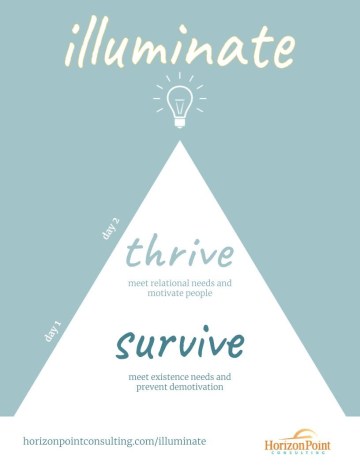
    What happens when we stack the pyramid in our favor? Innovation happens. And innovation is an absolute necessity in today’s VUCA world.  But we often limit innovation to products or processes and we don’t think about innovating people practices.


    That’s why we’ve launched Illuminate, to help you actually spend the time innovating your people practices.  Join us today- seats are limited.