Category: Next Generation Workforce and Workplace

We help individuals, organizations, and communities think innovatively about the next generation workforce and workplace. Read these forward-thinking stories and best practices from our work and lives.

  • The Economics of Union Activity

    The Economics of Union Activity

    Supply and Demand. The first lesson of Economics, or at least I remember it that way. The most important lesson of economics as I remember it. 

    Maybe I’m remembering it wrong, but I think the issues of the supply and demand of labor need to be reinforced when we think about anything and everything that is going on in our world. And one of those things is union activity. 

    The issues at Starbuck, Amazon, UPS… the list goes on and on about union organization and in the media seems on the surface to be about wages, benefits, and the overall treatment of workers. As Jillian pointed out in our last post,  People want to be valued and listened to.  They need to feel like they have some sense of control over their lives, and that includes at work.  Many employers don’t offer that.  When people don’t have this at work, they aren’t happy. 

    But none of that matters from a union sense if only one person feels that way. Many people have to feel that way. And when many people feel that way and there aren’t enough people to go around to fill the demand for labor, they have power.  Or in union terms, they have “collective bargaining” power. 

    And right now, there aren’t enough people to go around to fill jobs in many industries both in terms of the actual number of human beings available and or in terms of a desire to work in certain jobs or industries. And it is only going to get worse. 

    Typically, this issue of supply and demand for labor is measured by the number of job openings compared to the number of available workers. According to the Bureau of Labor Statistics, there have been more job openings compared to unemployed people since May 2021.  In January 2023, there were almost twice as many job openings as there were unemployed people in the United States according to this BLS data. 

    This challenge is not unique to the United States. Boston Consulting Group’s The Global Workforce Crisis- $10 Trillion at Risk  highlights the differences in labor supply and demand by country (both Germany and Japan are experiencing particularly acute issues with labor supply).  Whereas some countries are currently experiencing a higher level of supply than demand, the piece emphasizes that by 2030 most countries will experience labor shortages.  BCG postulates that this issue could result in $10 Trillion in GDP not created. 

    So, when there is more of a demand for labor than there is supply, employers better pay attention. We would hope they don’t have to pay attention because they are treating people like people. But when they aren’t, the most important law of economics will bite you.  Workers will all leave and go someplace else, because someone else needs them, because there are more jobs than people available to fill them. 

    We can be distracted by the media saying artificial intelligence (AI) is going to take over all our jobs, but the data doesn’t show this. We may need to retool ourselves for the jobs of the future, and that may be where employers need to be focused to not only help with labor supply issues but also to employee engagement issues. Both impact union activity. 

    What are you doing to impact labor supply and union activity? 

  • Could You Pass a Labor Relations Class?

    Could You Pass a Labor Relations Class?

    School is starting back, and that means I’m collecting the latest news on union activity – good, bad, and ugly – for a college-level labor relations course I’m teaching. Each of us at Horizon Point has a unique perspective on the union landscape through our work with various clients and projects, which we’ll be sharing in a series over the next few weeks. 

    I’m kicking us off with a look at union activity right here in our North Alabama region, featuring a snippet from the 2023 Wage & Benefit Survey. When asked if any employees are represented by a union, only 3% of participating companies said yes:

    All of these companies are in the manufacturing industry. Is that surprising? Why or why not? (I won’t grade you on it!)

    In the same wage survey, we ask questions about pay practices, compensation, and benefits – these factors contribute to employee satisfaction and whether or not they’ll seek unionization. You may have noticed that big names like Amazon, Starbucks, and UPS have been making news for employee union activity and the sometimes less-than-stellar response from corporate leadership. Workplaces are more advanced than ever before, but sometimes labor practices don’t keep up.

    SHRM recently published “The Evolution of HR and Labor Relations” for the Summer 2023 edition of HR Magazine. The biggest takeaway for me? The last sentence: 

    “The worker of today isn’t so different from the worker of yesterday in terms of their core human needs,” [Steve] Bernstein says. “What people really want in the workplace is to be listened to, to have access to decision-making and to be in a position to at least influence their workplace.”  

    Stick with us over the next few weeks as we explore further the changing (and stagnant) trends around labor relations and why it matters for YOU.

  • Application Process 2023

    Application Process 2023

    Should you Change your Application Process to make it easier for Candidates?

    A couple of years ago, we worked with a client who was having difficulty filling positions. They were using all the right avenues to get the word out to potential candidates, but the pipeline was not working. After surveying several candidates, we discovered the issue was with their extensive application process. It was lengthy and ultimately deterred candidates from completing their application. Fortunately, we helped them streamline by removing some of the steps to apply.

    Recently, a close family member applied for a position online and had the opposite experience. During a conversation, he shared that it was the “easiest process” he’d had while applying for jobs. He was asked two questions and had the option to upload a resume. Within a week, he was called in for an interview.

    In Alabama, the current unemployment rate is 2.2%. Which means, most everyone who wants to work is already working. This makes it tough for companies who are looking to expand their workforce. Making the application process easier for candidates is one way they can attract future employees. A few weeks ago, I was in a café that had “mini applications” placed throughout their dining area. I immediately took a picture, thinking of our clients & how we can help them increase their applicant pool.

    How can you streamline your hiring process? Consider what steps you can remove from the process all together. Save the paperwork for new hire orientation! Let us know if we can help.

  • Second Chances

    Second Chances

    Who among us has not needed a second chance in life? Have you been extended that grace? In my life I have been given chance after chance and have needed that opportunity to fail and to learn from those failures. When prisoners are released they are told that they cannot carry a fire arm and will not be eligible to vote but most times are not warned of the invisible barriers that exist in finding a job, housing or transportation. For example, you are good enough to buy a car but you cannot sell cars for a career. You must obtain housing but most will not rent to you due to your criminal record. 

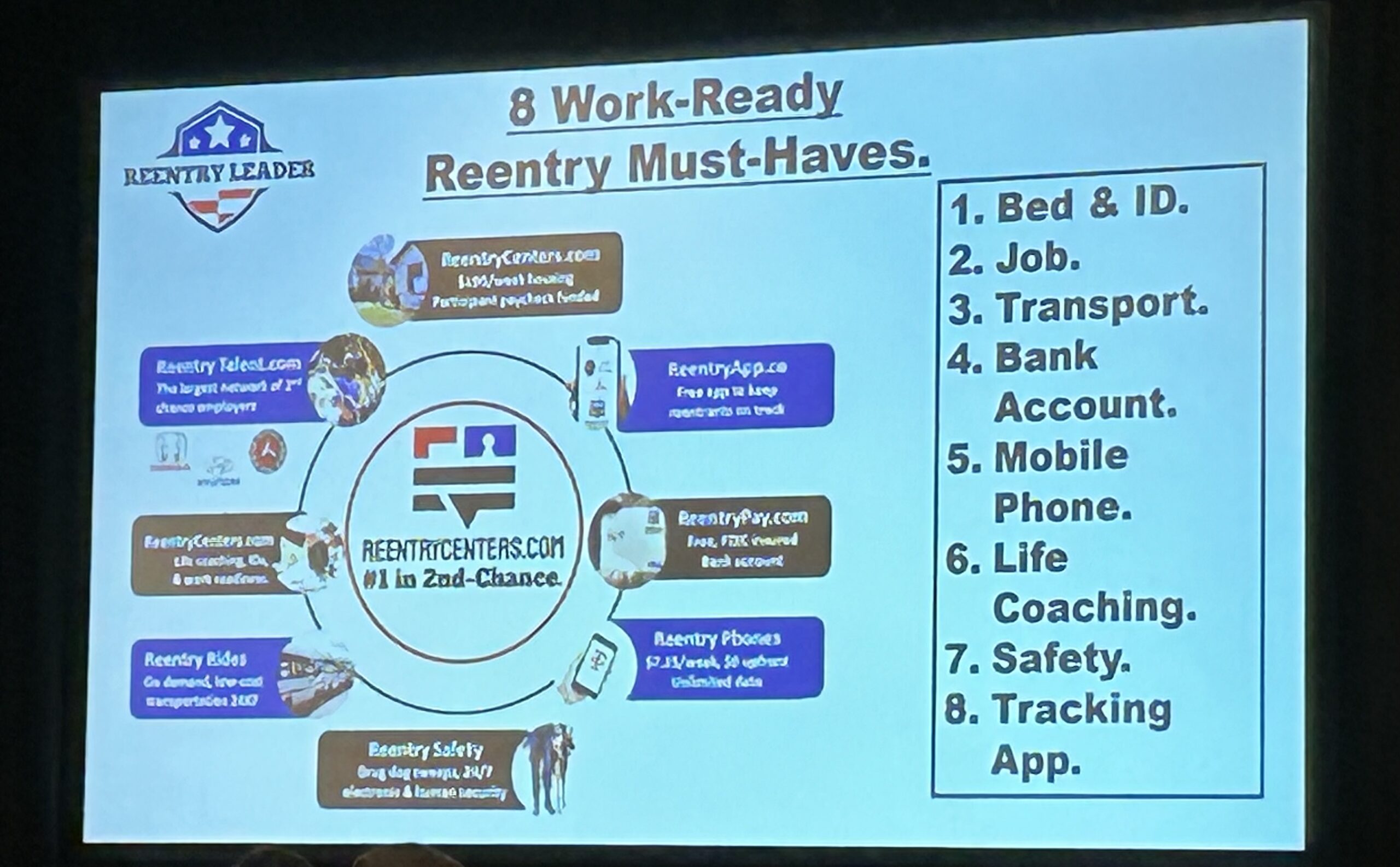
    On June 29th Lorrie, Mary Ila and I attended the first Reentry Leader Conference in Birmingham at the Hyatt Regency Wynfrey. As a subject that is near and dear to my heart, I was excited to hear about ways to help employers afford people a second chance. We have so much untapped talent and potential in Alabama and in the world. Studies show that 77% of our population is justice involved, that’s 32% more than the percentage of people who have college degrees. Depending on state, there are between 2-4 open jobs for every one person available to take that job in the industrial sector. Connecting those jobs to reentrants is critical. Of the 9.7 million reentry each year, only 8% can find employment.

    This is where Reentrycenters.com comes in. They equip participants with must haves such as affordable housing, food, transportation to appointments and counseling and most importantly good jobs. They even offer a free mobile bank for reentrants. Local Auto plants like Mercedes near the Reentry centers employ these workers. 

    During the 2nd chance employer Leader Session, Donny Jones from West Alabama Works shared about Building Hope West Alabama. Their passion is to “provide hope, help, and opportunity to people that are justice involved.” This program “connects justice-inolved individuals with meaningful jobs, as well as the job skills and educational credentials they need for long-term success.” Schnellke is one of the employers hiring people who are justice involved. They believe that everyone deserves a second chance.

    Chief Justice Sue Bell Cobb was the keynote speaker. She became judge at 25 and now runs RedemptionEarned.org. It is an effort to help worthy incarcerated adults to become productive citizens. Alabama has one of the highest percentages of the aging population incarcerated. Out of the 4002 total parole hearings in 2022 only 409 were granted parole.Their mission is “to identify, assist, and represent worthy individuals who have spent decades behind bars, demonstrated they are transformed, and earned parole or work release.”

    At Horizon Point we have a people first mindset. We believe that people are a company and community’s greatest asset. As one of the ladies speaking put it, which one of us has not made a mistake that needed forgiveness? How can your organization help to give “people” an opportunity after they have been held accountable for their actions? Afterall, don’t we all need a second chance?

    Need inspiration? Read more from The Point Blog here:

  • The Mental Health “Connection”

    The Mental Health “Connection”

    Recently, I traveled to North Carolina for our annual family vacation. On Sunday, we attended First Baptist Church of Bryson City. The guest Pastor brought the house down on that rainy day with a message on love and acceptance. He described the ways in which we used to value connection with one another through meal time and went on to emphasize how important social connection is for our mental health. If you feel connected and cared for, he argued, then love has the ability to heal. 

    That’s wonderful to hear about in Church, but how does that translate to the mental health of an organization or, more specifically, remote workers?  As a person who has experienced the struggle with mental health, I can testify that just today as I sit here from the comfort of my home writing this Blog I’ve had some anxious thoughts and feelings come up. The people that I love are gone for the day and while the silence is useful for my concentration, it can also be deafening and lonely. You see, I need that connection for inspiration and motivation.

    There are many benefits to hybrid work. Forbes said it best “Hybrid creates flexibility in our lives and workplace, which contributes to employee satisfaction and productivity. Making it easier for them to balance their work and personal lives can result in less stress and burnout. Hybrid work allows people to work in a comfortable and familiar environment, which can promote feelings of safety and well-being.”

    However, what goes up must come down, and there are pitfalls to this setup as well. When I began working from home in September, it was an adjustment. Coming from a traditional 9-5 work schedule, the idea of flexibility challenged my thinking. For a few days, I longed to catch up my with my co-workers and to hear the latest news when I walked through the door. You see, I wasn’t missing the stress or rigidity of the job, I was missing the connection with others. It is good for the body, mind and spirit.

    Thank goodness it didn’t take long for me to shift my perspective and see the way that my Horizon Point Team members valued connection as much as I did. According to Gallup analysis, “it finds that engagement has 3.8x as much influence on employee stress as work location. How people feel about their job has a lot more to do with their relationship with their team and manager than being remote or being on-site.”  

    How can your organization create space for mental health or connection in the workday or week while working remotely? Horizon Point uses various touchpoints throughout our weeks and months. Mary Ila and I meet once a week either in person, by phone or virtually to talk through what she needs me to handle. We also have a Monthly Mingle to brainstorm new ideas, discuss plans for the future and to share a meal. Quarterly Planning is a longer meeting where we, for lack of a better term, plan for the quarter. There are also One-on-Ones during the month when we meet with Mary Ila to have meaningful conversation about what’s happening and what we would like to see happening in our careers.

    What I initially thought could be a challenge has proved to be a learning opportunity. The traditional way of working doesn’t have to be my future, and I can still connect with my co-workers in various ways and environments. There are new tools that I have in my toolkit to connect with others, and when I’m feeling a little lonely, there are certainly other ways to find inspiration and engagement rather than in an office setting. 

    At Horizon Point, we value work-life integration, and it turns out that my stress level is much lower. Even on days like today when I have some anxiety, a nice walk or phone call with a co-worker or friend decreases that feeling. I am much more comfortable than I would be experiencing those feelings in an office setting. Therefore, my overall mental health is much more in balance. 

    Does your organization support your mental health? At Horizon Point, I feel connected and cared for, which translates to love and healing.

    To read more about connection and working remotely, browse through these topics at The Point Blog:

    What’s Relationshipping, and How Do I Do It?

    Building the Bridge Between Survive and Thrive in the Workplace

    4 Ways Leaders Can Keep Remote Work Pros from Becoming Cons

    Benefits of Remote Work for Employees