Category: Beyond Work

Beyond Work is our line of resources for people and community leaders looking for something new and innovative outside, be it a new job, career change, or personal development outside of work.

  • Women, Stay in the Room!

    Women, Stay in the Room!

    I was 24, interviewing for a job in economic development, of which I knew almost nothing about. Moving because of my husband’s job prompted me to start looking in my hometown, and an indirect connection had landed my résumé on the President’s desk.

    Through conversations with the President, I felt like this interview was just the last step before they would hire me.

    The board chair was there. I knew him, but not well. He was the mayor of our town when I was growing up.

    I never will forget what he said to me. “You know, economic development has always been a man’s job.” I momentarily thought, am I in the wrong place? Or in the wrong century?

    He went on to say, “Allison (the person who was in the Vice President role I was interviewing for and was leaving because she was moving) has shown me that women can do this job.”

    Gee thanks. Was he trying to compliment her or me or was he trying to put me in my place? I wasn’t sure. I didn’t yet know how to read him, but I did for the first time stop to think twice if this was the job I wanted. Not because I thought I couldn’t do a “man’s job” but because I didn’t want to work in a place that thought certain jobs were for women and certain ones were for men, and that I would have a higher standard of proving myself because of my gender.

    I took that job, and both the board chair and the President and CEO became an advocate for me. I am forever grateful to both of them.

    As I now sit at the #HRTechConf listening to the pre-conference sessions on Women in HR Technology, I was reminded of this conversation that took place almost ten years ago.

    Cecile Alper-Leroux, VP, HCM Innovation at Ultimate Software, told us after one panelist said she is typically the only woman in the room, to “Stay in the Room.” If women in the workplace want to gain relevance, they need to stay in the room.  Even if a man, or a woman, tells them that the job they are in or applying for is a “man’s”.

    To stay in the room you need to:

    1. Accept the invitation. Don’t let comments, like the ones I heard, keep you from accepting the invitation to a career path, job or simply the next meeting. Show up.
    2. Invite yourself. If you aren’t invited and you should be, invite yourself. If you had value to add, add it.
    3. Invite others. Hopefully, if you’ve earned a seat at the table, you’re helping another woman find her seat. Invite her to come along with you, to the meeting, to the conference, to the career path. And don’t assign her the role of taking notes. As Trish McFarlane said in this panel, “Women often bring each other down.” Pave the way for the next person to stay in the room by realizing that doesn’t require you to exit the room. It isn’t a competition.
    4. Invite your true self to the room. Be authentic – be you. You don’t have to act like a man to do this, or another woman, even if she is the one who invited you to the room. Know what makes you unique and bring that to the table to add value.

    Are you prone to stay in the room, exit, or never show up in the first place?


    Interested in learning more about diversity and inclusion? Join Mary Ila at SHRM’s Diversity and Inclusion Conference as she tackles the topic of hiring for fit AND diversity.

    See session information here.

  • 7 Ways to Make the Most Out of Your Next Conference

    7 Ways to Make the Most Out of Your Next Conference

    I’m in route to Las Vegas for the HR Technology Conference.   As I travel, I’m mindful of the tragic events of last weekend, and I am prayerful for all those who have experienced such senseless loss.

    But not traveling to this conference, and any other act of ceasing to live life because of the terrible acts of another, seems tragic too.   So as I head out to this conference that I think could be an impetus for us to shift our business direction, I have prepared to maximize its benefit.

    Here’s seven steps I’ve taken, and that anyone can take, to maximize the next conference on your agenda:

    1. Know why are you are going.

    There are multiple reasons I could be going to #HRTechConf that would be beneficial for me, our business and our clients.   My main reason for going, though, is to scope out the HR Tech scene firsthand with the end goal of deciding if we will pursue outside funding to build and launch an HR Tech solution.   With this in mind, it will shape all the decisions about how I spend my time there.  Know your purpose.

    2. Align your agenda to your purpose.

    I could get lost in adult ADD if I don’t keep my eye on the mission for attending. Most large conferences with multiple breakout sessions and vendors are this way.  Taking some time beforehand to align your agenda around three key areas is critical:

      • Sessions – I’m focusing my attention on sessions that relate to what is being funded now, sessions related to the sectors we are interested in pursuing, and of course around some key speakers I like.  I’m really excited about the Women in HR Technology portion of the conference. To see what I’ve mapped out to attend, check out my agenda here.
      • Vendors – Based on your purpose, you may or may not need to spend a significant amount of time dedicated to vendors.  I’m focusing my attention on vendors that are in the spaces we are interested in- talent acquisition, assessment and culture- as well as those that are focused on taking consumer driven technologies and applying them to HR. My marketing guru created a spreadsheet of all the vendors at HR Tech so that I can sort them by primary focus. She also made notes on interesting things to consider for some vendors that stood out.  To access this resource, click here.
      • Contacts – Outside of speakers and vendors, you should have a list of contacts in the field to make sure you catch-up with.


    3. Calibrate your agenda with someone who has been there done that.

    I’ve never been to HR Tech, so I need a little insider information to make sure I’m on track to make the most of my time there.   Thanks to Ben Eubanks with Lighthouse Research and Advisory for chatting with me the week before the conference.  The person you calibrate with can also most likely help connect you with important contacts if needed.

    4. Prepare to catalogue your learning in an organized way.

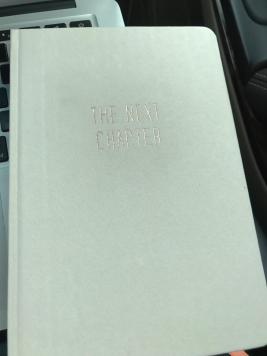
    Since I’m going to a tech conference, you would think I’m planning to organize my notes and takeaways using some kind of technology.   Initially though, I’ve got a trusty notebook, divided into sections with a couple of fun pens to get me started.   This will also help me have the chance to not only write but also draw anything that comes to mind.  I’m finding that drawing helps stimulate my thinking.    The new notebook is also aptly labeled “The Next Chapter”. Maybe this will provide some motivation….

    5. Schedule debrief time.

    Conferences offer a lot of information condensed in a short timeframe. If we don’t have a plan to decompress on that information, learning can be lost.   I have time on my schedule each day to debrief before moving on to #6 below.   I plan to do this by looking back over my notes, scheduling things and people to follow-up with (and sending LinkedIn invites right then) and writing some blog posts before I lose the value of some of the information.   Debrief time should be scheduled during the conference and after you get home.

    6. Schedule some fun.

    A secondary purpose of our trip to Las Vegas (or maybe it’s the primary depending on who you ask J) is to celebrate my husband’s 35th birthday.  He likes to gamble and I don’t, so he is looking forward to doing that while I’m at conference events.   But we’ve got some great dinners planned and a trip to the Rascal Flatts concert.  We are also getting in the day before the conference, so I plan to hit up some pool and shopping time then.  If we focus too intensely on our conference purpose, we might burnout and lose some of its value.

    7. Be flexible.

    I’m obviously hyper-organized about this conference (I’m usually not this way about a conference) because the excitement of what could be has motivated me. However, I realize we all need to be flexible and open to where happenstance might lead us when we’re in a large venue with a lot of people to build relationships with a lot going on to learn from.    If I get derailed from my agenda, it will be okay.  It may even lead to better things if I stay in tune with the purpose of my trip.


    Where are you headed for your next conference? Do you have a plan to maximize your time there?

    Like this post? You may also like the following posts about #HRTechConf

    Globoforce Blog

    Lighthouse Research and Advisory

    Steve Boese’s HR Technology

  • What is Diversity and Why Does it Matter?

    What is Diversity and Why Does it Matter?

    I distinctly remember the first time I knew I lived in a bubble.   I was 17- a junior in high school.  I had two elective slots open.  For one, I decided to be a science lab assistant that didn’t require much work.  This allowed me to walk across the street one day a week to spend time with an at-risk elementary student as her mentor.

    Up until that point in my life, I thought most people lived like me.  Some had more and some had less but I didn’t think there were drastic differences.  As I got to know this little girl and hear her story, I realized I was wrong.  Dead wrong.

    She and her brother had been shuffled from home to home, with no one really providing for them.   She didn’t know where her next meal would come from and who would (or wouldn’t) be picking her up from school and where she would sleep most nights.

    That same year, I also had a period of my schedule where I was an aide in the developmental wing of our high school.  I spent time with students around my age with varying degrees of cognitive and physical disabilities.

    This was the beginning of the realization that not everyone’s world, even if we were occupying the same physical space, was the same as the world I was in.

    With a large focus on diversity and inclusion in the workplace, my realization that I lived in a bubble helps to illustrate that diversity and inclusion aren’t just about your Title VII criteria and other subsequent legislative catagories- sex, race, color, national origin, religion,  age and sexual orientation.

    Diversity and inclusion aren’t about discrimination. It’s about creating an environment in work and in life that proves it is valuable to be around people who are different from us. This value is added through perspective and leads to business results.

    So when you think about your workplace (and life), do you have diversity and are you open to the perspectives around multiple criteria of diversity?

    Does it include diversity in:

    1. Demographics- Title IX criteria such as sex (and sexual orientation), race, color, national origin (I would also add geographic diversity- I’ve learned a lot from people who grew up in a different part of the United States than I have), and religion.
    2. Age
    3. Cognitive Diversity including things that many would label as “disabilities” like Autism, Asperger’s, etc.
    4. Physical Diversity including things that many would also label as “disabilities” tied to physical limitations- blind, deaf, paraplegic individuals, etc.
    5. Personality Diversity
    6. Socio-Economic Diversity
    7. Political Diversity
    8. Diversity of Experiences

    A lot of these areas of diversity can’t be seen.  They come with being heard.

    As a business leader, I’d encourage you to use the Privilege Walk  to begin the conversation of allowing a variety of areas of diversity to be seen (by the positions people end up in on the walk) and then be heard by facilitating a discussion around it.

    Because “companies with inclusive talent practices in hiring, promotion, development, leadership and team management generate up to 30% higher revenue per employee and greater profitability than their competitors.” Source here.

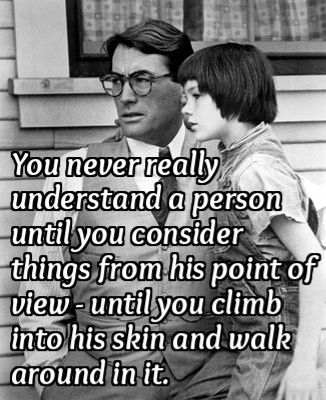
    I read To Kill A Mockingbird in High School too.  I was 15.  But it wasn’t until I was 17, walking into that little girl’s current front yard to take her to dinner that I realized I just learned what Atticus Finch meant, “You never really understand a person until you consider things from his point of view- until you climb into his skin and walk around in it.”

    Climb into someone else’s shoes today.  You’ll add more value if you do.


    Interested in learning more about diversity and inclusion? Join Mary Ila at SHRM’s Diversity and Inclusion conference as she tackles the topic of hiring for fit AND diversity.

    See session information here.
  • Do You Have a Plan of Action to Reach Your Goals?

    Do You Have a Plan of Action to Reach Your Goals?

    Action Planning and Goal Setting are key tools for career success. Stephen Covey’s “Circle of Concern vs Circle of Influence” principle is a great way to start the process. In short, we need to focus on our circle of influence (the things in life and career we can control).

    Source: INSITEMIND


    One way we can do this is by setting goals and creating an action plan. Goals should be specific, measurable, attainable, relevant and time bound.

    Source: Minute Movement

    Check out the Point Blog for more Goal Setting ideas:

    Goal Setting Articles from the Point Blog

    Develop an Action Plan for yourself with Smartsheet – free download here.

  • Creating Community in Your Organization

    Creating Community in Your Organization

    Shortly after the Charlottesville riots, I read an article about how the University of Virginia was responding to ensure that they continue to strive to be a diverse community that welcomes all in a safe environment. And it made me think, how can employers do the same?

    Many employers have diversity and inclusion programs, but are those programs truly successful? The recently publicized anti-diversity manifesto by, a now terminated Google employee, is a severe example of a diversity and inclusion program that may need revamping. I’d be curious to know if that manifesto has prompted Google to review their program.

    Bersin by Deloitte conducted a two-year research study published by Forbes.com in 2015 that showed “Companies that embrace diversity and inclusion in all aspects of their business statistically outperform their peers.” Their research shows that a truly successful diversity and inclusion program has an impact far beyond the HR aspect, it impacts the business as a whole.

    According to the study, those companies that emphasized leadership and inclusion in their talent strategy, were rated as exceptional organizations. Those companies, compared to the others in the study showed:

    • 3 times higher cash flow per employee over a three-year period
    • 8 times more likely to be able to coach people for improved performance, 3.6 times more able to deal with personnel performance problems, and 2.9 times more likely to identify and build leaders

    The study further showed that the two areas that had the greatest impact on business performance were the areas that focused on diversity and inclusion. Organizations that had successful programs saw the highest impact on their business performance.

    I once hired a speaker who specialized in diversity and inclusion training to speak at an organization where diversity and inclusion was a problem, and one simple thing he said has stuck with me. Diversity and inclusion is so much more than planning company potlucks and sticking everyone in the same room.

    Now is a great time to review your diversity and inclusion program. Does your organization strive to be a diverse community that welcomes all in a safe environment?

    To read the full Bersin by Deloitte study, click here.

    https://www.forbes.com/sites/joshbersin/2015/12/06/why-diversity-and-inclusion-will-be-a-top-priority-for-2016/#1fc15c572ed5

    Like this post? If you might also enjoy:

    Diversity and Inclusion in My Eyes and in the Eyes of My Children

    You can hire for fit AND diversity: How the most innovative companies hire

Subscribe to The Point Blog!

Our consultants write about new research, our work, our lives, and everything in between. Subscribe to The Point Blog for our weekly stories.