Author: Mary Ila Ward

  • What is Diversity and Why Does it Matter?

    What is Diversity and Why Does it Matter?

    I distinctly remember the first time I knew I lived in a bubble.   I was 17- a junior in high school.  I had two elective slots open.  For one, I decided to be a science lab assistant that didn’t require much work.  This allowed me to walk across the street one day a week to spend time with an at-risk elementary student as her mentor.

    Up until that point in my life, I thought most people lived like me.  Some had more and some had less but I didn’t think there were drastic differences.  As I got to know this little girl and hear her story, I realized I was wrong.  Dead wrong.

    She and her brother had been shuffled from home to home, with no one really providing for them.   She didn’t know where her next meal would come from and who would (or wouldn’t) be picking her up from school and where she would sleep most nights.

    That same year, I also had a period of my schedule where I was an aide in the developmental wing of our high school.  I spent time with students around my age with varying degrees of cognitive and physical disabilities.

    This was the beginning of the realization that not everyone’s world, even if we were occupying the same physical space, was the same as the world I was in.

    With a large focus on diversity and inclusion in the workplace, my realization that I lived in a bubble helps to illustrate that diversity and inclusion aren’t just about your Title VII criteria and other subsequent legislative catagories- sex, race, color, national origin, religion,  age and sexual orientation.

    Diversity and inclusion aren’t about discrimination. It’s about creating an environment in work and in life that proves it is valuable to be around people who are different from us. This value is added through perspective and leads to business results.

    So when you think about your workplace (and life), do you have diversity and are you open to the perspectives around multiple criteria of diversity?

    Does it include diversity in:

    1. Demographics- Title IX criteria such as sex (and sexual orientation), race, color, national origin (I would also add geographic diversity- I’ve learned a lot from people who grew up in a different part of the United States than I have), and religion.
    2. Age
    3. Cognitive Diversity including things that many would label as “disabilities” like Autism, Asperger’s, etc.
    4. Physical Diversity including things that many would also label as “disabilities” tied to physical limitations- blind, deaf, paraplegic individuals, etc.
    5. Personality Diversity
    6. Socio-Economic Diversity
    7. Political Diversity
    8. Diversity of Experiences

    A lot of these areas of diversity can’t be seen.  They come with being heard.

    As a business leader, I’d encourage you to use the Privilege Walk  to begin the conversation of allowing a variety of areas of diversity to be seen (by the positions people end up in on the walk) and then be heard by facilitating a discussion around it.

    Because “companies with inclusive talent practices in hiring, promotion, development, leadership and team management generate up to 30% higher revenue per employee and greater profitability than their competitors.” Source here.

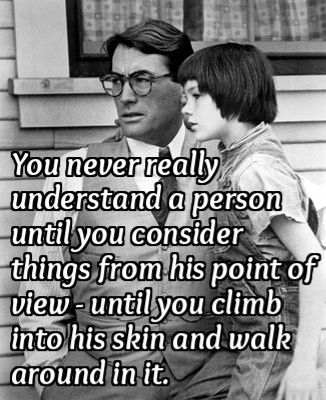
    I read To Kill A Mockingbird in High School too.  I was 15.  But it wasn’t until I was 17, walking into that little girl’s current front yard to take her to dinner that I realized I just learned what Atticus Finch meant, “You never really understand a person until you consider things from his point of view- until you climb into his skin and walk around in it.”

    Climb into someone else’s shoes today.  You’ll add more value if you do.


    Interested in learning more about diversity and inclusion? Join Mary Ila at SHRM’s Diversity and Inclusion conference as she tackles the topic of hiring for fit AND diversity.

    See session information here.

  • Tiny Homes, RVS and Millennials- What this all means to your employee benefit and engagement strategy

    Tiny Homes, RVS and Millennials- What this all means to your employee benefit and engagement strategy

    The demand for tiny homes and RVs is on the rise. And millennials are driving these sales. As an article in USA Today stated,

    Trailers, not motor homes, make up a large part of this growth, now accounting for 87% of the units sold, the association says. Buyers are likely to be Millennials, those in their 20s or early 30s, including a lot of young couples who don’t have kids yet….

    For Buckles and many other first-time RV buyers, the focus is more on the short term. She and her husband Josh hope to use their new trailer to drive to barbecue competitions and enjoy the outdoors in her local area, which means that summer — and the freedom that comes with it — is just an RV purchase away.

    And from thetinylife.com:

    What are tiny houses? The tiny house movement? Tiny living?

    Simply put, it is a social movement where people are choosing to downsize the space they live in. The typical American home is around 2,600 square feet, whereas the typical small or tiny house is between 100 and 400 square feet. Tiny houses come in all shapes, sizes, and forms, but they enable simpler living in a smaller, more efficient space.

    People are joining this movement for many reasons, but the most popular reasons include environmental concerns, financial concerns, and the desire for more time and freedom. For most Americans 1/3 to 1/2 of their income is dedicated to the roof over their heads; this translates to 15 years of working over your lifetime just to pay for it, and because of it 76% of Americans are living paycheck to paycheck.

    So what is the alternative? One solution might be to live smaller. While we don’t think tiny houses are for everyone, there are lessons to be learned and applied in order to escape the cycle of debt in which almost 70% of Americans are trapped.

    The trend in different ways to live, travel and find leisure for younger Americans also points to trends in lifestyle preferences that are important for employers to take note of, especially when it comes to employee benefits that lead to engagement and retention:

    1. Keeping up with the Jones’ isn’t as much of a priority as it once was. This isn’t your baby boomer generation that desires above all else income and traditional benefits from their employer. This isn’t the day and age where employees are as concerned as previous generations about competing with the Jones to buy the two story house with the 2 car garage and 2.5 kids that a steady pay check and a climb up the corporate ladder can help facilitate.
    2. Experiences are extremely important. RVs allow us to get out and see the world. Tiny houses create a unique living experience for the owner. Millennials value experience and the flexible work arrangements that facilitate experiences.
    3. Debt is an issue. Many younger workers have racked up college debt that their parents and grandparents never would have imagined dealing with before they even started a career. As the cost of a college education continues to rise, it’s important to think about how the debt equation affects worker benefits and engagement.

    With all these trends, employers would be wise to revamp benefits packages around them. This would include more flexible and experience-based work arrangements (for candidates and employees), packages that focus on helping to pay off college debt (even over retirement savings packages like your traditional 401ks), and al a carte benefit options that allow employees the flexibility to choose what they need when they need it.

    Have you rethought how to revise your benefits structure to meet the needs of today’s worker?

  • Is the role of the millennial male changing the way they lead at work?

    Is the role of the millennial male changing the way they lead at work?

    If you still watch TV these days and don’t fast forward through the commercials, you’ll begin to notice a trend. More and more consumer products commercials are now geared towards men, not women. Men are washing the clothes, buying the groceries, making purchases for their children and making the decisions that we typically associate with females/mom.

    CBS Sunday Morning piece recently cited that 80 percent of dads born after 1980 are the primary grocery shopper.  The piece goes on to highlight the changing role of men in the home:

    “A father would come home, read the newspaper, not pay much attention to the kids really, and still be considered a good father because he was making the family financially stable,” said psychologist Ray Levy, who grew up in the 1950s, when dads were expected to be breadwinners and disciplinarians, but not much else.

    “Nobody actually believed that fathers could be warm and soft. That was an unusual father,” he said.

    We know now kids that get time and attention from their fathers do  better in school, on the job, and in their own relationships — that’s according to research that barely existed a generation ago.”

    What peaks my interest in this is not the hype over the millennial spin, but the thought that an increasing role for men in caregiving in the home leads them to be more caring leaders at work.  (Thanks Trish McFarlane and Steve Boese of HR Happy Hour for sharing this thought on their Mr. Mom podcast.)

    Breadwinners and disciplinarians in the 1950s can be tied to the idea of command and control management of that time. In today’s world, is a dad now being seen as a nurturing caregiver in the home consistent with the shift to a caring coach as leader in the workplace?

    And does practicing these skills at home help male leaders apply them on the job and visa versa?

    Of course on any topic related to the difference between men and women in the workplace, I ask my husband what he thinks. On a Saturday morning run, I broached the topic with him.

    He is a very caring, nurturing and involved father with our two children, but he- from the way I see it at least- is less of this at the office than he is at home, for a variety of reasons.  He also assumes most of the male associated homemaking roles in our home, for example, mowing the grass, whereas I assume the more traditional females roles- laundry and groceries. We divide and conquer usually on the cooking duties.

    His initial reaction was that experience in general, whether in the home or at the office- leads a person, male or female- to be more caring. Because working with a variety of people over time, he says, allows you to learn how to read people and respond to their needs accordingly. Servant-based leading is what came to mind for me through his thoughts.

    So as I hope we all strive to be more caring, compassionate leaders, maybe it isn’t necessarily having kids to care for at home that creates this for us. Maybe it is seeing needs in the home and at the office and meeting them, regardless of the traditional roles associated with that task.  Seeing our personal lives and our work lives as fluid not separate places where needs can and should be met helps to mold us into the leaders that we need to be.  And maybe breaking down some gender roles with guys buying groceries and doing the laundry helps us all to break down gender stereotypes at work as well.

    Maybe I should get out and mow the grass this weekend…


    Where do you best serve at home and at the office?

  • We’re Only Human podcast – Calculating the Value of HR Programs

    We’re Only Human podcast – Calculating the Value of HR Programs

    Mary Ila had a chance to chat with Ben Eubanks on the We’re Only Human podcast about the importance of calculating the value that HR programs and efforts bring to business.  You can tune in below to learn more about how and why to calculate ROI and run statistical calculations to prove the value of your efforts.

    A big thanks to Ben and the HR Happy Hour Network for the chance to chat about this important topic!

    Listen to Mary Ila’s interview with Ben here.

  • Be Leary of the First Impression

    Be Leary of the First Impression

    I spent some time (finally) reading for pleasure over the 4th of July holiday week.  A new author, Amor Towles, has struck a cord with me, and I finished up reading A Gentleman in Moscow over the break.

    The writing is eloquent and thought-provoking, and this quote resonated with me as a keen lesson:

    After all, what can a first impression tell us about someone we’ve just met for a minute in the lobby of a hotel? For that matter, what can a first impression tell us about anyone? Why, no more than a chord can tell us about Beethoven, or a brushstroke about Botticelli.  By their very nature, human beings are so capricious, so complex, so delightfully contradictory, that they deserve not only our consideration, but our reconsideration– and our unwavering determination to withhold our opinion until we have engaged with them in every possible setting at every possible hour.

    In the world of talent management, we often label people based merely on first impressions.  Someone gets the tag “Hi-Po” for whatever fleeting reason, and they remain so even when their performance doesn’t dictate it.  And even a greater tragedy, the reverse happens and we write someone off as a low performer when we haven’t taken the time to initially consider or reconsider (as the author emphasize is more important) the context of the person and their overall performance.

    In other words, don’t judge a book by its cover, or its title.  If I had done so, I wouldn’t have ever discovered this gem or a quote or this gem of an author.  And you and I both may be passing up on gems in and for our organization because we haven’t taken the time to get to know them “in every possible setting at every possible hour.”

    Who do you need to reconsider?