Author: Jillian Miles Massey

  • 4 Ways to Get Unstuck with Professional Development

    4 Ways to Get Unstuck with Professional Development

    We all experience moments of feeling stuck. Maybe it’s a lack of clarity on next steps, difficulty overcoming a challenge, or simply feeling uninspired; whatever the reason, it can be hard to push through and continue growing. However, professional development doesn’t have to feel like a solo struggle. There are tools and methods available to help get you unstuck and moving forward. Below are four resources we use at HPC to help teams and individuals break through barriers and develop professionally.


    1. One-on-Ones

    The power of one-on-one meetings cannot be overstated when it comes to personal and professional development. At HPC, we know firsthand how effective these conversations can be when structured thoughtfully. Our one-on-ones with our leader provide space for focused dialogue, allowing us to reflect on our goals, challenges, and progress. What makes them especially impactful is that they create an opportunity for Mary Ila to give us real-time feedback and guidance, which is crucial for our growth.

    We also help clients implement effective one-on-ones, and to help them get used to the purpose and process, we’ve started incorporating resources from the One-on-Ones Box by The Unstuck Box (see more about them next!). This toolkit provides a structured way to ensure these conversations go beyond surface-level check-ins.

    With guided prompts and thought-provoking questions, this resource helps managers and team members dig deeper into their challenges and aspirations. It’s all about driving meaningful development in a way that feels both supportive and actionable. The tools allow for conversation around everything from performance feedback to goal setting, which keeps the sessions focused and results-driven.

    2. The Unstuck Box

    You heard me right with the One-on-Ones Box – the company who makes these is literally called The Unstuck Box. As the name suggests, this tool is designed to help individuals and teams overcome roadblocks that prevent progress. Professional development can sometimes feel like a series of unsolvable puzzles. The Unstuck Box provides practical methods to approach these challenges with fresh perspective.

    In a recent training session for a non-profit leadership group, Taylor used the Performance Improvement Box, using the cards to prompt creative problem-solving and help the team explore new ways to handle tricky issues. It’s been a game-changer for our training sessions, helping leaders feel empowered to tackle problems that may have previously felt overwhelming.

    3. FranklinCovey Cards

    When it comes to unlocking potential, sometimes the right question or challenge can spark an “aha” moment. That’s where FranklinCovey comes into play. I attended the ATD International Conference & Expo this year, and FranklinCovey had Elevate Performance Cards exclusively for ATD attendees. I snagged a box, Taylor used them during a leadership development session for a client, and the results were impressive. Participants were asked to respond to real-world scenarios, and the exercise opened up deep conversations about performance, communication, and strategy.

    The Elevate Performance cards are designed to promote reflection and encourage team collaboration. By reviewing a challenge together, participants explore different perspectives and brainstorm a range of solutions. This not only encourages critical thinking but also helps teams work more cohesively. These cards will now be a staple in HPC training, offering a simple yet powerful tool for driving group development and performance improvement.

    4. SparkPath Challenge Cards

    Career exploration can be a daunting process, especially for younger individuals who may not yet have a clear vision of their professional path. To support students in exploring their potential career options, we use SparkPath Challenge Cards at HPC. These cards are specifically designed to help middle and high school students think beyond traditional job roles and focus instead on real-world challenges they’re passionate about solving.

    By introducing students to the idea that their career can be shaped around the problems they want to address, the SparkPath cards open up a world of possibilities. We’ve found that this method inspires creativity and critical thinking, encouraging students to take ownership of their professional development at an early age. It’s a fantastic way to help young people get unstuck when they’re unsure about their future.


    Each of these resources offers a unique approach to professional development, but they all share one common goal: helping individuals and teams overcome obstacles to growth. Sometimes we simply find ourselves stuck, as Mary Ila talked about last week. Her advice to a colleague (and to herself) was this: Start with one thing. What is one thing you want to grow in? Not ten things, not three things, one thing. 

    Whether you’re working one-on-one, in a group, or guiding young students, these tools provide practical ways to get unstuck, one thing at a time. 

  • Investing in People Makes Cents

    Investing in People Makes Cents

    Last week, Emily kicked off our new series on professional development. What it is and why we should care about it. I’m pulling that thread to talk about the dollars and cents of why you should invest in people and why you should do it NOW.

    I just read a powerful article from McKinsey titled Increasing your return on talent: The moves and metrics that matter that hit me square in the face with this quote: “McKinsey research indicates that companies that put talent at the center of their business strategy realize higher total shareholder returns than their competitors.”

    One more time for the people in the back: spending money on your people makes you more money. McKinsey’s research let them to the startling stat that some companies could be missing out on $480 million a year just by not investing in employee engagement and skill development.

    screen capture of a graphic from the McKinsey article linked in this blog

    McKinsey goes on to lay out a 5 step plan for companies to “maximize their return on talent”, and it’s a an excellent plan that relies on an already existing, already strong HR team. If that doesn’t describe the situation at your company, you might not be ready for McKinsey’s 5 step plan. Instead, maybe you need the Dollar Tree plan.

    Last week, I had lunch with a great friend who also works in the HR space. She recently stepped in for me to facilitate some pro-bono training when I couldn’t make the date work. Her tactic? Conversation cards from Dollar Tree.

    image of a box set of conversation cards used in training facilitation

    She spent $3.75 plus tax on conversation cards that turned into meaningful relationshipping for the group and several people left interested in adopting conversation cards with their own teams. Weeks later, my friend is still riding the high of a $3.75 investment. When we invest in people, it’s about the intent and the follow through more than the amount of money spent.

    Horizon Point’s operating values include Continuous Learning & Improvement, and it’s truly part of everything we do. Our operating values make up the structure of our planning meeting agendas. Seriously, the line items are grouped by value:

    1. People First
      • Catch up
      • Review accomplishments
      • Schedule one-on-ones
    2. Productivity
      • Company performance
      • Open projects
      • Business development
    3. Continuous Learning & Improvement
      • Review program & project feedback
      • Identify continuing ed / professional dev opportunities
    4. Give Back
      • Volunteer leadership
      • Financial support

    Just the act of talking about our learning with intention generates engagement and a future-focused mindset. But the impact is compounded when we put our money where are mouths are. I asked Mary Ila today about Horizon Point’s investment in continuous learning for team members, and the total so far this year is over $10,000, just for the 5 of us. She doesn’t hesitate to invest in people, as long as the purpose is aligned with the mission of our work at HPC and, of course, as long as the investment is reasonable and works in the current budget. Our work is about talent development and better workplaces, and it only counts if we practice our own preaching.

    To close the loop on the McKinsey research, they reported that:

    the most effective organizations encourage personalized, adaptive learning. Employees are motivated to own their journeys by deciding which skills and areas of expertise they want to focus on. They are given feedback, along with coaching and peer-learning opportunities, and they are supported by a digital ecosystem that can help them track their progress over time.

    We strongly agree with this approach, and we spend a lot of time and resources talking about it and being about it. We learn together, we learn individually, and it’s all based on the skills or areas we want to develop. As McKinsey puts it, we own our journeys. We also train and coach our clients on this adaptive learning model using our Leaders as Career Agents process. We help them customize learning opportunities that drive their organizations forward and create more value.

    To invest in people is to invest in a thriving future. Talk about it and be about it. Investing in people makes cents!

  • AI for Talent Development: Good, Scary, or Both? 

    AI for Talent Development: Good, Scary, or Both? 

    AI is everywhere. Have you recently googled something and used the AI generated answer without ever clicking a link from the list? It’s one of my new favorite efficiencies…and it freaks me out a little. In the “if something scares you, it probably means you should do it” kind of way. We’ve been talking about AI for HR over the last few weeks in the context of our work and industries we support, and today I’m wrapping it up with my take on AI for talent development as a whole. It freaks me out a little, so it’s probably a good thing. Right? 

    Speaking of Google’s AI Overview, here’s what came up when I googled “is AI for talent development?”: 

    Yes, AI (artificial intelligence) is being used in talent management to improve efficiency and outcomes at every stage of the talent lifecycle. AI technologies like machine learning algorithms and natural language processing can help with:

    Recruitment 
    AI can help match candidates with roles based on their skills, experience, and cultural fit. AI-powered semantic search can also help recruiters find qualified candidates by running Google-like searches that go beyond keyword matching.
     

    Employee development 
    AI can help create personalized training plans, learning suggestions, and development goals for each employee. AI can also provide real-time feedback based on performance data, which can help employees make immediate improvements. 

    Performance management 
    AI can help set dynamic goals and provide actionable insights to drive employee performance and development. AI can also help with succession planning by analyzing employee data to identify high performers and predict future leadership needs. 

    Skills intelligence 
    AI-powered tools can help HR leaders gain an in-depth view of their workforce’s skills and potential knowledge gaps. This information can help leaders evolve job architectures as skill needs and business priorities shift.

    For each topic featured in the AI Overview, Google provided links to the source material used to inform the AI response. I wanted to know more about AI in Recruitment, so I clicked the link icon and found more detailed articles: 

    (Shoutout to Avature and HireRoad)

    If you’ve kept up with the latest news at Horizon Point, you likely know that I (Jillian) just returned from a 6-week paid sabbatical. During that time, I slept a lot, I made time for hobbies, and I let my brain slow way, way down. Now coming back to work, it’s nice to ease into slow productivity and learn to incorporate the good of AI into our talent development work. 

    I don’t think anyone can say for sure what the future of AI for HR holds, but for now, let’s be curious and explore AI for talent development with open minds. After all, the simple definition of development is the act of improving by expanding, enlarging, or refining, and AI can certainly help. 

  • Be Creative Anyway: How ATD24 Made Me Feel Better About AI

    Be Creative Anyway: How ATD24 Made Me Feel Better About AI

    Attending the ATD24 International Conference made me feel so energized and prepared for another year around the sun in talent development. The obvious buzzword: Artificial Intelligence (AI). I walked away with pages and pages of notes on AI in training and development. Mary Ila kicked off our series on AI last week, so now I’m sharing a rundown (written in part using ChatGPT) of my key AI takeaways from ATD24.

    Generative AI: The Game-Changer in Scenario-Based Learning

    One of the sessions that really stood out to me was “Use Generative AI to Create Scenario-Based Learning” by Kevin Alster and Elly Henriksen from Synthesia. They showed us how generative AI can take the heavy lifting out of creating scenario-based learning (SBL). Imagine being able to quickly craft engaging, real-world scenarios that captivate your learners and improve retention.

    The tools and frameworks they demonstrated were incredibly user-friendly, making it feasible for anyone to enhance their courses without needing a PhD in AI. This session made it clear that SBL, powered by AI, is not just a future concept but a present-day reality that can significantly elevate our training programs.

    Navigating the Inclusion Maze with AI

    Then there was the eye-opening session by Mychal Patterson of The Rainbow Disruption, titled “AI Doesn’t Mean ‘Always Inclusive.’” This was a deep dive into the potential pitfalls of AI when it comes to diversity, equity, and inclusion (DEI). Mychal highlighted some serious risks, like biased data leading to exclusionary outcomes and the lack of diversity in AI development teams. These are real challenges that can undermine your DEI efforts if not addressed properly.

    This session was a reminder that while AI offers huge benefits, we need to implement it thoughtfully and inclusively to avoid reinforcing existing biases. We’ve written about inclusive training before, and now we are reminded to be more intentional with avoiding language and representation bias, with or without the use of AI.

    Demystifying AI for Leadership Development

    DDI also showed up strong with Patrick Connell’s session, “Demystify AI for Development: What’s Hype, What’s Real, and What to Do,” which struck a perfect balance between optimism and practicality. He debunked some common myths about AI (i.e. we’re not all losing our jobs) and showcased how it can be a real asset in leadership development.

    From using AI-driven assistants for data analysis to generating personalized content, Connell provided a roadmap for integrating AI into our strategies in a way that enhances, rather than overwhelms. This session made AI seem less daunting and more achievable. Since the conference, HPC has practiced using AI to write first drafts of program learning objectives, training outlines, and more.

    Redesigning Training Programs to Stay Relevant

    Another session that hit home for me was actually during the Chapter Leaders Conference that some of us from ATD Birmingham attended prior to the International Conference. The session was “Making it Competitive: Redesigning Your Chapter Programming to Offer Relevant Knowledge, Skills, and Abilities” by Miko Nino. Miko stressed the importance of continuously updating and evaluating our training programs to keep pace with the changing demands of employers and learners. Using technology to assess and enhance curriculum effectiveness was a major highlight.

    The session also covered developing marketing and financial plans to ensure these programs are not only impactful but also sustainable. It was a comprehensive guide to making our training offerings more competitive and relevant.

    Tackling AI Integration Challenges

    Of course, the conference didn’t shy away from discussing the challenges of integrating AI in training and development. But the consensus was clear: with careful planning and a commitment to ethical considerations, we can mitigate the risks.

    For us, an example might be clearly identifying when something we deliver is made with AI, even in small part. If we use AI to create graphics or images that we share in marketing or in training programs, we need to clearly label those as made with AI. We’re all still learning how to use AI ethically, and it starts with a good faith effort on the front end.

    So…What’s Next?

    ATD24 gave me so many insights on AI in training and development. The sessions highlighted how AI can help make learning more personalized, efficient, and inclusive. But they also underscored the need for thoughtful implementation; the future of T&D is not just about adopting new technologies, but about doing so in a human way that truly enhances learning for everyone.

    For now, my AI journey is all about “do it anyway”. Feel intimidated by AI and use it anyway. Don’t feel very creative? Create anyway. Using AI in my work helps me be creative anyway, and that’s a positive in my book.

    Image made with AI to illustrate the idea of “create anyway”
  • Matthew McConaughey Inspired Me and 8,000 Other People

    Matthew McConaughey Inspired Me and 8,000 Other People

    I finally had the opportunity to attend an ATD International Conference & Exposition, known as ICE by true ATD-ers. This year’s event in New Orleans featured a stellar lineup of keynote speakers, a broad range of learning sessions, and countless opportunities for relationshipping and professional growth.

    Matthew McConaughey Was There

    Known for his captivating storytelling and unique perspective on life, Matthew McConaughey’s keynote, “Greenlights: Rethinking Success and Leadership,” drew from his personal experiences and professional journey. He shared insights from his #1 New York Times bestselling memoir, Greenlights, which chronicles his life’s pivotal moments and the lessons learned along the way. 

    His speech emphasized the importance of resilience, authenticity, and embracing life’s challenges as opportunities for growth. McConaughey’s engaging storytelling and down-to-earth wisdom resonated deeply with attendees, leaving them inspired to lead with courage and creativity in their own careers​.

    And So Was Artificial Intelligence

    That section about Matthew McConaughey was written with ChatGPT (except for the picture I took from wayyyy in the back). Since I got home from the conference, I’ve been challenging myself to use more AI tools. I’m a Millennial, I’m no Zoomer digital native. 

    I’m excited about the potential of AI in helping HR and TD professionals provide higher quality services, and I’m also bristling at the fact that I’m not very good at using it yet. I like being good at things (set up for the next section on Daniel Pink!), and I’m not good at AI. But I’m trying. That’s probably the biggest takeaway for me from ATD42; none of us in talent development are all that good at using AI just yet, but we’re trying! 

    I Filled Up My Notebook

    I took feverish notes during every session I attended. I’m usually the one just taking pictures of the slides (I still did) and maybe sending myself links to view later. ATD24 was so juicy for me that I had to scribble down everything everyone said for 4 days. 

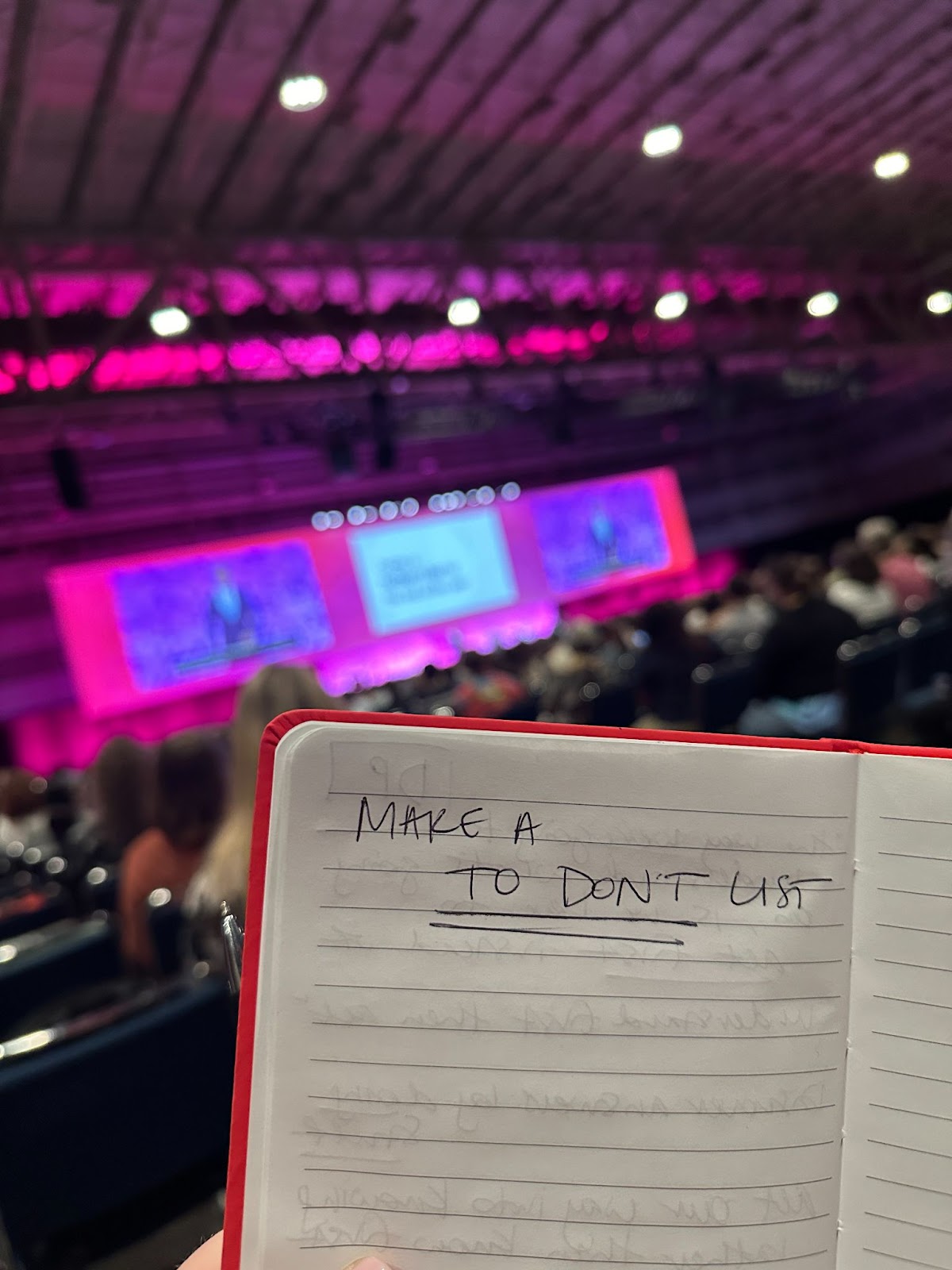
    My favorite note that I immediately shared with the HPC team was from Daniel H. Pink, one of our all-time favorite authors. He’s cheeky. He grounds his writing in real, relevant research. The quote I wrote down, underlined, and sent to the team was, “Make a To Don’t List”. 

    This is a picture of a notebook held up in front of the stage at a conference. The notebook has the words, "Make a To Don't List" written on it.

    For context, Dan meant that sometimes we get so stuck on “getting sh*t done” that we get in our way. In his own life, his To Don’t List includes things like:

    • Don’t start the day answering emails 
    • If I’m not willing to do it next week, don’t say yes to it 

    Dan also says he keeps a notebook at his desk that is specifically for acknowledging and recording progress. At the end of every day, he writes down 3 ways he made progress. He admits that he never looks at it again, but the act of writing down his progress to close out the day helps him leave his desk feeling accomplished. I’m going to try it, and I hope you will, too. 

    There Was Something For Everyone

    This section was also written using ChatGPT, when I asked it to summarize the conference. It’s a pretty good summary! ATD has something for everyone. 

    Learning Tracks and Sessions

    The conference featured a diverse array of learning tracks designed to cater to various aspects of talent development and HR management. These included:

    1. Career Development: Focused on helping professionals advance their careers and develop others’ skills.
    2. Future Readiness: Addressed the skills and knowledge needed to prepare organizations for future challenges.
    3. Instructional Design: Covered the latest trends and best practices in designing effective learning experiences.
    4. Leadership & Management Development: Aimed at enhancing leadership skills and strategic management capabilities.
    5. Learning Sciences: Explored evidence-based methods for improving learning and performance.
    6. Learning Technologies: Examined the use of technology to facilitate learning in the modern workplace.
    7. Managing the Learning Function: Discussed strategic approaches to managing learning and development programs.
    8. Measurement & Evaluation: Focused on assessing the effectiveness of talent development initiatives.

    Networking and Expo

    The ATD Expo was a major highlight, featuring exhibitors showcasing the latest tools, technologies, and services in talent development. It provided attendees with hands-on experiences and the opportunity to explore innovative solutions that can enhance their organizations’ learning and development programs.

    Additional Highlights

    • Preconference Learning: Offered intensive workshops and certificate programs for deep dives into specific topics.
    • Career Center: Provided career coaching, resume reviews, and networking opportunities to help attendees advance their professional journeys.
    • Virtual Experience: Ensured that those unable to attend in person could still participate in key sessions and network with peers virtually..

    How is Your Soul? 

    The theme for ATD24 was Recharge Your Soul. I absolutely felt recharged when I left, so much that I couldn’t stop talking about it (still can’t). 

    Robert “X” Fogarty asked us in the opening session how our souls were doing, and I can’t speak for anyone else, but I needed to hear that. So much of what we do in HR and Talent Development comes from the soul. If the soul’s not doing so hot, the impact isn’t there either. 

    X started Dear World, and I totally recommend checking it out. At Horizon Point, we are People First and we put People First, and we believe that people’s stories are important. Dear World is all about using stories to inspire and connect people. Take a look at their work, and also ask yourself, “How is your soul?”.