
Category: Next Generation Workforce and Workplace

We help individuals, organizations, and communities think innovatively about the next generation workforce and workplace. Read these forward-thinking stories and best practices from our work and lives.

  • Everyone Gets a Trophy and The Skills Gap

    Everyone Gets a Trophy and The Skills Gap

    At a lunch meeting yesterday, one topic of discussion was the “everyone gets a trophy” generation. The millennial generation – of which I am barely a part of based on my date of birth, but rarely admit to being – seems to have a problem with feeling entitled. And the negative outcomes this creates in schools and int he workplace is a hot topic.

    A couple of issues cited in this discussion were:

    • Lack of respect for consequences of one’s actions. For example, a star pitcher not getting to pitch in a game when scouts were there because he missed a practice and was also in trouble at school for skipping class. His parents raised holy terror because he didn’t get to play. Who is to blame? The parents or the student?
    • Lack of respect for other people and their time. For example, a teenager not showing up for work to teach swimming lessons because she had play practice and no one called to let the family know the child would not have lessons because the teacher couldn’t make it. Is the paid work or the play practice more important to attend? The director of the play told her she couldn’t miss practice. Does getting a paycheck for something also communicate you can’t miss?

    Compare these to examples to key findings cited in the Alabama Skills Gap Study conducted by the Alabama Department of Labor:

    Employers were more likely to identify gaps in soft skills (41%) than in technical skills (38%).

    Of the employers who have identified gaps in soft skills, 65% stated that Attendance was a problem. Following Directions and Time Management were the next most often identified soft skill gaps (39% and 36% respectively).

    We could blame these skills gap issues on just one generation, but the numbers show employers must be facing it with the majority of their workforce, which can’t possibly be all made of just the trophy winners.

    So what should we do? First, we should focus on soft skills development just as much as we do technical skills development in our schools and in our homes. A good resource for soft skills curriculum can be found here: http://www.dol.gov/odep/topics/youth/softskills/

    Next, we need to turn the mirror on ourselves, whether as a parent or as a teacher or even as a student. The question becomes, am I guilty of what I’m complaining about and how do I model the behavior I want to see?

    I say this as I sit here, letting my three year old skip swimming lessons. He’s asleep next to me after having tried to wake him up from his short-lived nap to go to the lesson. You haven’t seen holy terror until you’ve tried to wake a three year old up who doesn’t want to be woken up. Yep, that person complaining about the teenager teaching swimming lessons was me and now here we are not going to a scheduled lesson. Am I teaching my son something I don’t want to be teaching him? Sure am. But at least I called to let them know we wouldn’t be there… (I know don’t tell me, because I know, we still should have gone).

    As I beat myself up about not doing what I know I should, I figured I’d at least share the lesson. Soft skills are important. They are learned. Teach them by modeling the behavior you want to see.

    Want more on the soft skills employer want? Check out these posts:

    What do employers want? The 4 Cs

    What do employers want? Creativity
    What is your smart phone teaching you about communication?

    Want to get a job? Foster collaboration

  • 6 Reasons NOT to Strive for Perfection

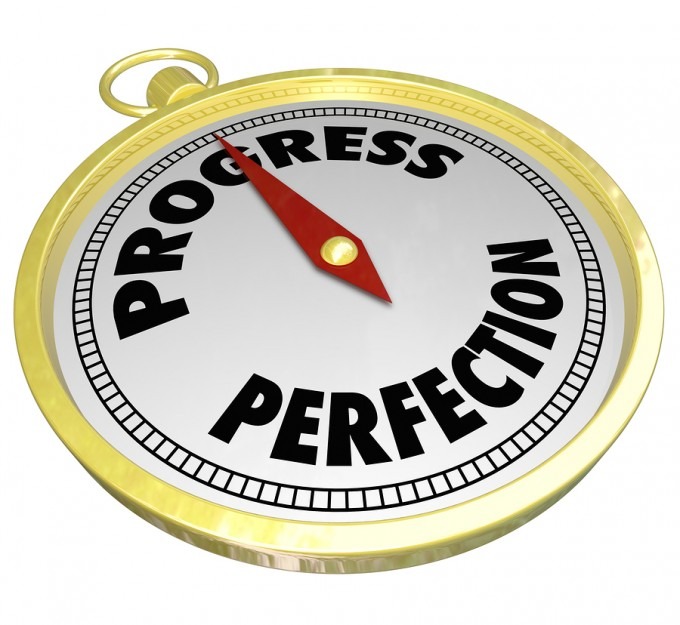
    6 Reasons NOT to Strive for Perfection

    I used to get so frustrated as a recruiter when I asked the question “What are your weaknesses?” in an interview and I would get the response “I’m a perfectionist.” It seemed to me to be a way to state a “weakness” when in reality striving for perfection, I thought, was a characteristic that is desired in the working world and in fact classified as a strength.

    I’d turn around and probe the applicant in a way that made them tell me what bad behaviors or results arose because of their perfectionism. Most people just stared at me after asking this question. I wanted to say,  “Now give me an answer to this question that isn’t canned!”

    But, now I’m beginning to believe perfectionism truly is a weakness. Here’s why:

    Perfectionism leads to paralysis. In other words, decisions aren’t made because of perfectionism.

    The inability to make decisions leads to stuff not getting done. Number 23 in the article 30 Things to Stop Doing to Yourself,  states “#23. Stop trying to make things perfect. – The real world doesn’t reward perfectionists, it rewards people who get things done.

    When stuff doesn’t get done, the organization can’t meet customer needs and can’t move forward. You can’t vision for the future and think strategically when you are always trying to make things perfect.

    Perfectionism in the extreme sense is really is just another word for neurotic. If you know a true perfectionist, then you know what I mean. One client engagement I had last year was to improve their hiring practices in order to improve organizational results. After performing an analysis, it was obvious that we needed to implement some type of screening that tested for neurosis. Low performers were exhibiting this characteristic over and over and it was often described as “perfectionism”.

    Learning doesn’t occur when things are perfect.  We often learn more from our failures than our successes, which drives continuous improvement. And continuous improvement does move people and organizations forward.

    Quite frankly, perfect is boring.  And it is never going to happen.

    So if you want to drive results and strategic thinking in your organization, stop telling your people that they need to deliver “perfect”.  Tell them instead they need to be better today than they were yesterday- striving for continuous improvement.  A little bit better today than yesterday is a lot better than being paralyzed today because yesterday wasn’t perfect.

  • Flexibility to Reduce Workplace Stressors

    Flexibility to Reduce Workplace Stressors

    I attended a seminar last week discussing ways to improve productivity and communication in the workplace. One thing that stood out to me in the presentation was the emphasis the presenter placed on eliminating stressors so that people could be innovative and creative. He placed a value on innovation and creativity as the only differentiating factors in creating a sustainable advantage.

    What if standard or traditional work arrangements are creating workplace stressors and reducing innovation and creativity?

    This leads me to consider a tie to a book I mentioned last week,  The Elephant and the Flea  and its emphasis on employing free agents. Charles Handy writes,

    “Meantime, more and more people are going to become aware that their knowledge which drives innovation and creativity has marketable value. They will be reluctant to sell it for a time-based contract, a wage or a salary.  They will want to charge a fee or a royalty, a percentage of the profits.  The difference is that a salary is paid for time spent, whereas a fee is money paid for work produced, irrespective of the time spent on it.” (italics mine.)

    The beauty of this model is that you not only get results, but you get people who are less stressed because they are in control of their own situation, which allows them to be creative and innovative and produce better results.  It also may cost you less.  Many who charge a fee for work produced don’t come with the added cost of a benefit package.

    Or consider the FutureWork Institute described in the book Now You See It. Describing the founder of the institutes philosophy, the author Cathy Davidson writes,

    “The workplace of the future had to start taking into account the life desires, not just the work ambitions, of workers.  She was convinced that the best, most creative workers in the future might not be workaholics with the eighty-hour workweeks, but people who had figured out what way they love to work and how they work best.”


    My two year old snoring is eliminating my stress and fostering my creativity…

    As I sit hear writing this post on a Saturday at home, my two year old is asleep in my lap.  Although it took a little maneuvering to get him situated so that I can type,  I can’t help but think that creativity does come when we are in control of when and how work gets done. But maybe that’s the point… blurring the lines of work and life so much that you don’t realize to consider it work, which fosters creativity and innovation.  What could eliminate stress and make writing more enjoyable than two year old contently asleep in your lap?

    What way do you love to work and how do you work best?


    Like this post? You may also like this one as well.